Modern software teams build under constant pressure to deliver faster, scale reliably, and adapt to changing user expectations. That makes the choice of tools and frameworks far more than a technical preference; it shapes productivity, collaboration, security, and long-term cost. This article explores how modern development stacks are selected, how they influence delivery, and what organizations should evaluate before committing.
How Modern Development Tools Shape Software Delivery
Software development has changed from a largely isolated coding activity into a deeply connected discipline where planning, coding, testing, deployment, observability, and maintenance form one continuous lifecycle. In this environment, tools and frameworks are not just accessories. They determine how quickly teams can validate ideas, how safely they can release updates, and how effectively they can maintain quality as systems grow more complex.
At the center of this shift is the demand for speed without sacrificing reliability. Businesses expect rapid feature delivery, but users also expect stable, secure, and intuitive digital experiences. To satisfy both, development teams rely on layered toolchains that support automation, standardization, and visibility across the entire workflow. A well-chosen stack reduces repetitive work, minimizes handoff friction, and allows developers to focus more on solving user problems than on managing infrastructure or boilerplate code.
Frameworks play a particularly important role because they create structure. Instead of building every application component from scratch, teams use frameworks to establish conventions for routing, state management, security, testing, and data handling. This improves consistency across projects and makes onboarding easier for new developers. It also lowers the likelihood of architectural drift, where different parts of the application evolve according to conflicting patterns and assumptions.
Front-end development offers a clear example of this transformation. Modern interfaces are expected to be responsive, interactive, accessible, and highly performant across devices. Frameworks such as React, Angular, and Vue have become popular not simply because they allow component-based development, but because they support maintainable patterns for building complex user interfaces over time. Their ecosystems include testing libraries, build tools, state management solutions, and developer experience enhancements that make large-scale interface development more predictable.
On the back end, frameworks and platforms help teams standardize APIs, business logic, authentication flows, and data access patterns. Whether teams use Node.js ecosystems, Python-based frameworks, Java platforms, or .NET solutions, the larger principle is the same: reduce custom plumbing and establish repeatable development practices. This is essential when systems must integrate with cloud services, external APIs, analytics platforms, and security layers, all while handling growing volumes of data and traffic.
The rise of cloud-native development has increased the strategic value of tool selection even further. Applications are now frequently deployed as distributed services rather than monolithic binaries. Containers, orchestration systems, infrastructure-as-code tools, and CI/CD platforms allow organizations to package and deploy software consistently across environments. However, they also increase operational complexity. Teams that choose tools without considering integration, learning curve, and maintenance overhead often end up with fragmented workflows that slow delivery instead of accelerating it.
That is why the conversation around modern stacks increasingly focuses on alignment rather than novelty. The best tools are not always the newest or most popular; they are the ones that fit the team’s skills, system requirements, delivery model, and business goals. A startup validating a product idea may optimize for rapid prototyping and flexibility, while an enterprise operating across regulated markets may prioritize governance, traceability, and long-term support.
Development culture also influences tool effectiveness. The same framework can produce excellent or poor results depending on how teams collaborate around it. If a team lacks documentation standards, testing discipline, or code review habits, even the strongest technology stack can become difficult to scale. Conversely, modest tools supported by strong engineering practices often outperform more fashionable stacks used without discipline. This is why mature organizations assess frameworks not just in terms of features, but in terms of the behaviors they encourage.
Another major factor is ecosystem stability. Tools with broad community support, active maintenance, and extensive educational resources tend to reduce implementation risk. They make it easier to troubleshoot issues, hire talent, and integrate with third-party services. When evaluating platform choices, many decision-makers look beyond raw technical capability and ask practical questions: Is the documentation clear? Are updates predictable? Is there a healthy plugin ecosystem? Can we avoid lock-in if requirements change?
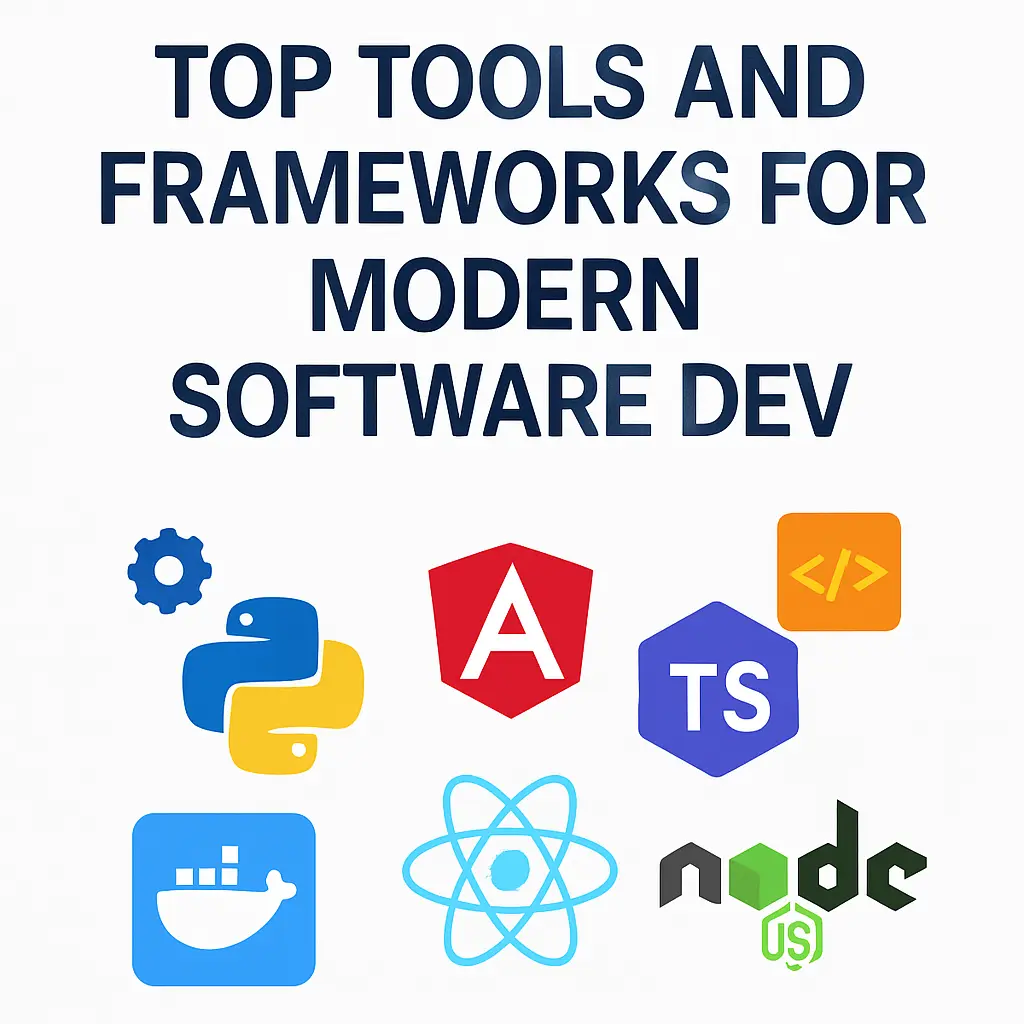
For teams trying to identify current options, resources like Top Tools and Frameworks for Modern Software Dev can provide a useful starting point. Still, such lists are most valuable when treated as entry points into deeper evaluation rather than final answers. Every tool exists within a broader context of architecture, process, budget, and organizational maturity.
As software products become more integrated with core business operations, tooling decisions increasingly affect competitive performance. A development stack influences release frequency, defect rates, developer retention, and customer satisfaction. In many cases, it even shapes how quickly a company can enter a market or respond to user feedback. Choosing well therefore requires a balanced understanding of technology, workflow, and long-term maintainability.
How to Evaluate Tools and Frameworks for Long-Term Success
Selecting modern software development tools should begin with a clear understanding of the problem the team is trying to solve. Too often, organizations adopt technologies because they appear in trend reports or because competitors are using them. This creates stacks that are impressive on paper but poorly matched to real operational needs. Effective evaluation starts with context: product goals, expected scale, compliance constraints, team expertise, delivery frequency, integration needs, and maintenance capacity.
One of the first considerations is architectural fit. A framework should support the type of system being built rather than forcing developers into patterns that conflict with core requirements. For example, an application with heavy real-time interaction may benefit from technologies optimized for event-driven communication and responsive interfaces. A data-intensive platform may require frameworks with strong support for asynchronous processing, queue management, and robust database abstractions. The point is not to find a universally superior tool, but to identify one whose strengths correspond to the system’s dominant demands.
Developer productivity should also be assessed carefully and honestly. Productivity is not just about writing code quickly. It includes how easily teams can debug issues, test changes, enforce standards, and collaborate across roles. A framework that accelerates initial development but produces opaque behavior or difficult upgrades may reduce productivity over time. Sustainable velocity comes from clarity, repeatability, and low friction in everyday work.
Testing support is a critical part of that equation. Modern delivery practices depend on the ability to ship updates frequently with confidence. This is impossible without reliable test automation integrated into the development workflow. Teams should examine whether a framework supports unit testing, integration testing, mocking, end-to-end validation, and performance testing without requiring excessive customization. Good testing ergonomics often separate stacks that scale successfully from those that become fragile under business pressure.
Security should never be treated as a secondary consideration. Frameworks influence authentication, authorization, session management, input validation, dependency handling, and data exposure. Secure defaults are especially valuable because they reduce the number of risky decisions developers must make manually. Tooling should also support vulnerability scanning, secret management, audit logging, and patching discipline. In a world where software supply chain risk is under growing scrutiny, dependency ecosystem quality matters as much as core framework design.
Integration is another area where many stack decisions succeed or fail. Modern software rarely operates alone. It typically interacts with cloud providers, payment gateways, messaging services, analytics systems, monitoring platforms, customer data systems, and internal APIs. Teams should evaluate how easily a framework fits into this broader environment. Strong integration support lowers implementation time and reduces brittle custom connectors that become expensive to maintain.
Performance and scalability must be considered in realistic terms. Not every application needs to optimize for hyperscale from day one, but every application should avoid architecture choices that create obvious bottlenecks. The right framework should make it easier to manage caching, concurrency, load distribution, and efficient resource usage. Equally important, it should provide visibility into system behavior through logging, tracing, and metrics. Without observability, performance issues often remain hidden until they affect users directly.
Team capability is often the most underestimated variable in technology selection. A stack is only as effective as the people implementing and operating it. If the team lacks experience in a sophisticated framework, the resulting codebase may become inconsistent and hard to maintain. Training can solve part of this problem, but leaders must weigh learning investment against delivery timelines. In some cases, a less complex framework with strong familiarity will produce better outcomes than a technically superior but poorly understood alternative.
Maintenance horizon matters as well. Organizations should ask how the framework behaves over three to five years, not just during the first release cycle. Are updates frequent and manageable? Is backward compatibility respected? Does the tool have a healthy roadmap? Can the codebase remain understandable as more engineers contribute? These questions are especially important for enterprise systems that outlive the original development team.
Cost should be evaluated beyond licensing. Open-source tools may appear inexpensive, but hidden costs can emerge through training, integration work, infrastructure demands, support gaps, and migration complexity. Commercial platforms may carry direct fees but reduce operational overhead through managed services, security support, and enterprise-grade reliability. A realistic financial view compares total cost of ownership, not just initial adoption expense.
Governance is another key consideration for organizations operating at scale. Standardized tooling can improve compliance, reduce duplicated effort, and simplify support models across multiple teams. However, excessive standardization can also suppress innovation when applied rigidly. The best approach is usually a governed core with controlled flexibility: define approved frameworks and infrastructure patterns for common use cases while allowing justified exceptions for specialized needs.
Organizations should also examine the role of AI-assisted development within modern tool ecosystems. Code generation, intelligent autocomplete, automated testing suggestions, and documentation support are changing how developers work. Yet these capabilities create new evaluation questions around accuracy, security, privacy, and code ownership. AI features can significantly boost productivity when paired with strong review practices, but they should complement engineering discipline rather than replace it.
A practical evaluation process often includes several stages:
- Requirements mapping: define business and technical priorities before considering products.
- Shortlisting: identify tools that match system type, team skills, and operational needs.
- Proof of concept: test frameworks against a realistic use case rather than a trivial demo.
- Operational review: evaluate deployment, monitoring, security, and support implications.
- Lifecycle assessment: estimate maintenance burden, upgrade path, and long-term viability.
- Decision documentation: record why the stack was chosen so future teams understand trade-offs.
This kind of structured evaluation prevents reactive decision-making and creates alignment between engineering and business leadership. It also reduces the risk of adopting tools that solve local developer preferences while creating broader organizational inefficiencies.
The most successful teams view frameworks as part of a system of delivery, not as isolated technical products. A front-end library, an API framework, a build pipeline, a test platform, a container strategy, and an observability stack all influence each other. If one layer introduces friction, the entire workflow suffers. That is why stack design should focus on coherence. Tools should connect naturally, reinforce consistent practices, and support the organization’s preferred operating model.
In this sense, modern software development is less about finding perfect technologies and more about building a resilient environment for continuous improvement. Teams need tools that make quality visible, automation reliable, and change manageable. They need frameworks that help them evolve architecture without excessive rewrites. They need platforms that support both current delivery demands and future growth. For additional perspective on stack choices and evolving ecosystems, Top Tools and Frameworks for Modern Software Development can serve as a helpful reference point when comparing categories and use cases.
Ultimately, the strongest technology decisions are grounded in trade-off awareness. Every framework offers benefits and imposes constraints. Mature teams acknowledge both. They resist hype, validate assumptions through implementation, and design stacks around actual product and organizational needs. This approach does not eliminate complexity, but it makes complexity intentional and manageable.
Choosing modern software development tools is really about choosing how a team will work, scale, and adapt over time. The right frameworks support speed, quality, security, and maintainability as one connected system rather than as separate goals. By evaluating tools through architecture, productivity, integration, governance, and long-term fit, organizations can build stacks that serve both immediate delivery needs and durable business growth.