Modern software development depends on choosing the right mix of tools, frameworks, and workflows to build fast, secure, and scalable products. This article explores how today’s development ecosystem supports everything from planning and coding to testing, deployment, and long-term maintenance. It also explains how teams can evaluate options wisely and align technical choices with business goals.
Building the Modern Development Stack
Software development has changed from a mostly isolated coding activity into a highly connected discipline that blends architecture, collaboration, automation, and continuous improvement. A modern development stack is not just a set of programming languages or libraries. It is an ecosystem of tools that helps teams design systems, write cleaner code, test with confidence, deploy frequently, and maintain quality over time. When organizations talk about development speed, they are often really talking about the efficiency of this ecosystem.
At the foundation of any stack is the programming language and framework layer. These choices influence developer productivity, application performance, security posture, and the ease of future maintenance. Front-end frameworks such as React, Angular, and Vue continue to dominate web interfaces because they simplify component-based development and help teams manage interactive user experiences at scale. On the back end, Node.js, Django, Laravel, Spring Boot, and ASP.NET remain popular because they offer mature ecosystems, strong community support, and reliable ways to structure complex applications.
Frameworks matter because they reduce the need to solve common problems from scratch. Routing, state management, authentication, input validation, database access, and API design are recurring concerns in software projects. A strong framework provides patterns and conventions that make development more predictable. This predictability is important not only for speed, but also for team alignment. When code follows known patterns, onboarding becomes easier and debugging becomes less chaotic.
Still, the best framework is not always the newest or most fashionable one. Teams need to evaluate several practical dimensions before committing to a technology stack:
- Project complexity: A lightweight application may benefit from a simpler framework, while enterprise software may require stronger structure and built-in tooling.
- Team expertise: Tools that match the existing skills of developers often deliver better results than theoretically superior tools that introduce a steep learning curve.
- Performance requirements: Real-time systems, high-traffic platforms, and data-heavy applications may prioritize speed, concurrency, or efficient rendering.
- Security needs: Framework maturity matters when sensitive data, regulatory requirements, or public-facing services are involved.
- Community and ecosystem: A healthy ecosystem means better plugins, more educational resources, and faster resolution of issues.
- Long-term maintenance: Tools should be assessed for longevity, release discipline, and upgrade stability.
Development tools extend far beyond frameworks. Version control platforms such as Git, GitHub, GitLab, and Bitbucket have become central to team collaboration. They do more than store code. They enable branching strategies, pull request reviews, issue linking, change audits, and collaborative workflows that support distributed teams. In a modern environment, good version control practices are inseparable from quality software engineering.
Integrated development environments and code editors also shape productivity in meaningful ways. Visual Studio Code, IntelliJ IDEA, WebStorm, PyCharm, and similar platforms reduce friction through syntax highlighting, intelligent autocomplete, code navigation, debugging support, extension ecosystems, and built-in terminal access. These features might appear minor in isolation, but over the life of a product they save hundreds of hours and improve consistency across teams.
Package managers and dependency tools are another essential layer. npm, Yarn, pnpm, pip, Maven, Gradle, Composer, and NuGet help developers consume open-source libraries quickly. Yet this convenience introduces risk. Dependency sprawl can create performance issues, version conflicts, and security vulnerabilities. Mature teams treat dependency management as a strategic task rather than a background detail. They audit libraries, remove unused packages, pin important versions, and monitor vulnerability reports continuously.
The conversation around development tools increasingly includes platform engineering and containerization. Docker transformed how teams package applications by ensuring consistency across local development, testing, and production environments. Kubernetes added orchestration capabilities that make it easier to scale, manage, and recover distributed applications. These technologies are especially important in microservices architectures, where multiple independently deployable services must operate reliably together. Although they can introduce complexity, they also reduce environmental inconsistency, which has long been a major source of bugs and deployment failures.
Cloud-native development has pushed teams to think beyond simple application delivery. Infrastructure as code tools such as Terraform and Pulumi enable environments to be provisioned consistently and repeatably. This changes the nature of deployment from a manual operation into a versioned engineering process. As a result, teams gain better traceability, faster disaster recovery, and a more disciplined approach to scaling.
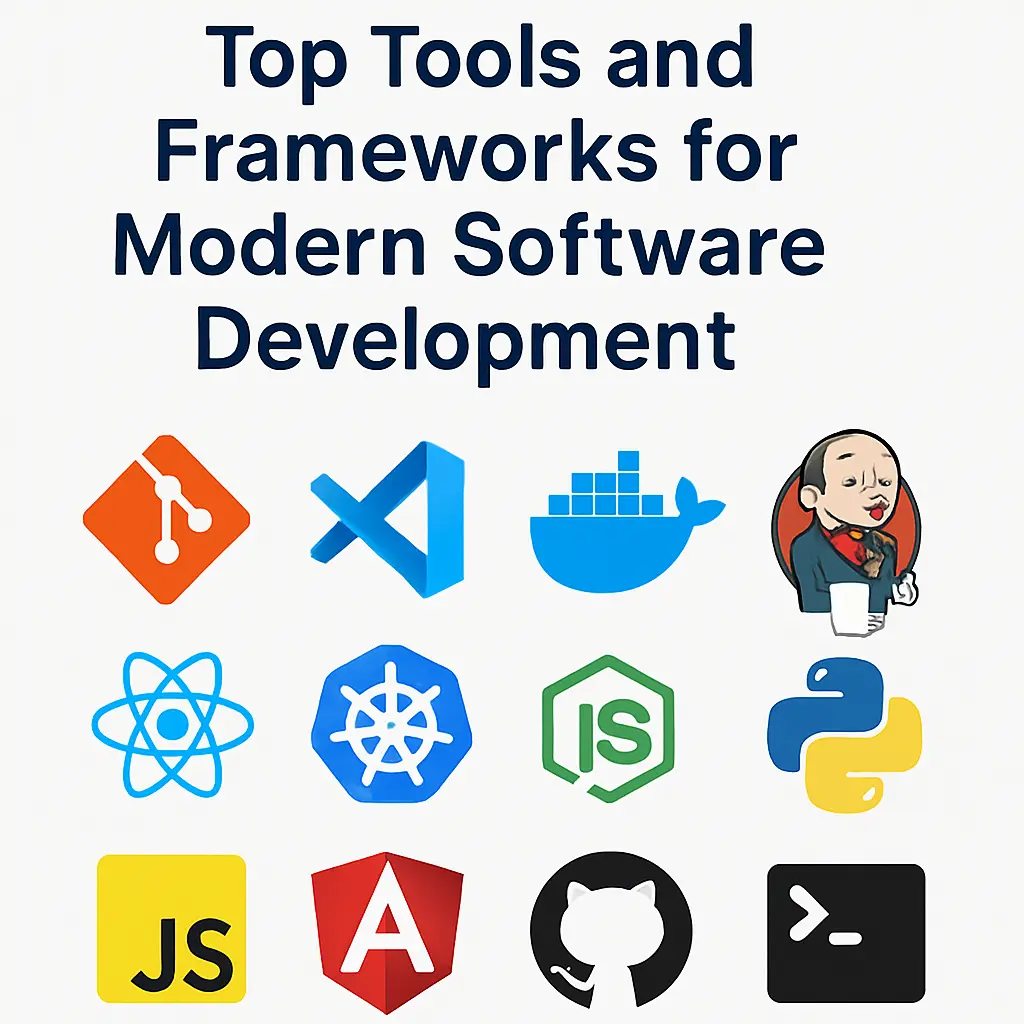
Developers exploring stack options often review curated resources and comparative guides before making decisions. For broader context on ecosystem choices, many teams examine references such as Top Tools and Frameworks for Modern Software Development, especially when comparing practical strengths across multiple categories. Such references are most useful when they are treated as starting points for evaluation rather than universal answers.
One common mistake organizations make is separating tool selection from business strategy. Technical leaders may focus on elegance, while stakeholders focus on delivery speed, cost, and market timing. The strongest stacks are chosen where these concerns meet. A technically advanced stack that the team cannot maintain will slow growth. A minimal stack that cannot support future product demands will eventually create architectural debt. Good engineering leadership recognizes that tools are business decisions as much as technical ones.
From Tool Selection to Sustainable Delivery
Once a development stack has been selected, the real challenge begins: turning isolated tools into a coherent delivery system. Modern software teams succeed not because they own advanced tools, but because they connect those tools into workflows that reinforce quality and speed at every stage. This is where testing, automation, observability, and collaboration practices become central.
Testing is often discussed as a distinct phase, but in high-performing teams it is embedded throughout development. Unit testing ensures that individual functions and components behave correctly. Integration testing checks that services, databases, and APIs work together as intended. End-to-end testing simulates real user interactions. Performance testing reveals bottlenecks under load. Security testing identifies weaknesses before attackers do. These different forms of validation create layers of confidence that allow teams to release more frequently without multiplying risk.
Automation is what makes this level of testing sustainable. Continuous integration pipelines can run code quality checks, execute test suites, build artifacts, and detect regressions whenever new code is submitted. Continuous delivery and deployment pipelines extend this process into controlled release workflows. Tools such as GitHub Actions, GitLab CI, Jenkins, CircleCI, and Azure DevOps help standardize these operations. The real value of CI/CD is not only speed. It is reliability through repeatability. Manual processes may work occasionally, but automated pipelines create a dependable release habit.
Code quality tools are equally important in sustainable development. Linters, formatters, static analyzers, and code scanning platforms help identify style inconsistencies, logical errors, maintainability issues, and security weaknesses early. ESLint, Prettier, SonarQube, CodeQL, and similar tools turn abstract quality goals into measurable engineering practices. When these checks run automatically, they reduce subjective debate and free reviewers to focus on architecture, logic, and user impact.
Review culture itself is a powerful tool, even if it is not software in the traditional sense. Pull request reviews, pair programming, and design discussions improve code quality while spreading knowledge across a team. They reduce dependency on individual contributors and lower the risk of hidden complexity accumulating in one area of the system. Effective reviews are not about gatekeeping. They are about creating a shared technical standard and a shared understanding of the product.
As software systems grow, observability becomes critical. Logging, metrics, tracing, and alerting allow teams to understand how applications behave in production. This is particularly important in distributed systems, where problems may emerge from interactions between services rather than from a single component. Tools such as Prometheus, Grafana, Datadog, New Relic, Elastic, and OpenTelemetry help teams move from reactive troubleshooting to proactive monitoring. Observability shortens recovery time, improves incident response, and gives product teams insight into real-world performance.
Security must also be integrated into the full lifecycle. Modern applications depend on APIs, cloud infrastructure, third-party packages, and distributed data flows, all of which expand the attack surface. Secure development practices include secret management, dependency scanning, access control policies, encryption, environment isolation, and regular patching. Security can no longer remain a final checkpoint before release. It has to be treated as an engineering discipline embedded in planning, coding, testing, and deployment.
The rise of DevSecOps reflects this shift. Instead of treating security as external to development, DevSecOps incorporates automated scanning, policy enforcement, and secure defaults directly into delivery pipelines. This approach is valuable because it aligns security with development velocity rather than forcing teams to choose between them. The more security is built into everyday workflows, the less disruptive compliance and risk management become.
Another major trend in sustainable delivery is the use of internal developer platforms. As systems become more complex, many organizations create standardized environments that abstract away repetitive infrastructure concerns. These platforms may provide preapproved templates, deployment pipelines, logging defaults, service catalogs, and policy guardrails. The goal is not to limit developers, but to let them focus on product logic rather than rebuilding support infrastructure repeatedly. Platform engineering is becoming one of the most important responses to the operational complexity of modern software.
Yet organizations should be careful not to confuse more tools with better performance. Tool overload can reduce productivity if systems are poorly integrated or if developers must constantly switch contexts. Every addition to the stack should answer a clear need, fit into existing workflows, and produce measurable value. Strong teams periodically review their toolchains and ask practical questions:
- Does this tool remove friction or add another layer of administration?
- Is adoption broad and consistent across the team?
- Can it integrate cleanly with our existing systems?
- Does it improve delivery speed, reliability, security, or visibility in a measurable way?
- What is the long-term maintenance cost of keeping it?
These questions matter because technical debt does not come only from rushed code. It also emerges from bloated toolchains, fragmented standards, and inconsistent workflows. Sustainable development requires intentional simplification. The best engineering organizations are often not those with the most sophisticated stacks, but those with the clearest and most disciplined ones.
Documentation is another overlooked element of sustainable delivery. Good documentation preserves architecture decisions, onboarding knowledge, API behavior, runbooks, and deployment instructions. Without it, even excellent tools can become difficult to use consistently. Documentation should not be seen as separate from development. It is part of the product’s maintainability and one of the strongest defenses against organizational memory loss.
Looking ahead, artificial intelligence is beginning to influence how developers work. AI-assisted coding, automated test generation, intelligent code search, and natural-language-based documentation support can speed up routine tasks. However, these systems are most effective when used inside a strong engineering process. They do not replace architecture thinking, code review, or operational discipline. Instead, they amplify the value of teams that already work well. In weak processes, AI may increase output without improving quality.
The future of development will likely be shaped by a combination of abstraction and accountability. Teams will rely on higher-level frameworks, automation platforms, and AI support to move faster, but they will also need deeper visibility into quality, cost, and system behavior. This means the ideal modern toolchain is not simply fast or popular. It is transparent, maintainable, secure, and aligned with how the organization builds value.
For teams refining their approach, comparative reading can help validate internal assumptions and uncover gaps in tooling strategy. A useful example is Top Tools and Frameworks for Modern Software Development, which can support broader evaluation when considered alongside project-specific technical and operational realities.
Ultimately, modern software development is about designing a system that helps people do their best work repeatedly. Frameworks accelerate implementation, automation improves consistency, testing protects quality, and observability supports resilience. But none of these elements creates success on its own. Their value comes from how well they are connected and how closely they support the real needs of developers, users, and the business.
Choosing tools and frameworks for modern software development is not a one-time technical task but an ongoing strategic process. The strongest teams build stacks that balance speed, quality, security, and maintainability while staying flexible enough to evolve. By connecting frameworks, automation, testing, and observability into one disciplined workflow, organizations can deliver better software consistently and make smarter long-term engineering decisions.