Modern software development moves quickly, but speed alone does not create reliable products. Teams also need the right tools, clear processes, and frameworks that support quality, collaboration, and scalability. This article explores how today’s development environments are built, which technologies matter most, and how businesses can choose practical solutions that improve delivery without adding unnecessary complexity.
The Foundation of Modern Software Development
Modern software development is no longer defined by coding alone. It is a connected system of planning, collaboration, testing, deployment, monitoring, and ongoing improvement. Teams that produce high-performing digital products understand that tools and frameworks are not isolated technical choices. They influence architecture, developer productivity, user experience, security, and the long-term maintainability of the application.
At the center of this shift is the need to build software faster without sacrificing resilience. Traditional development approaches often separated departments into distinct silos. Developers wrote code, testers checked it later, operations deployed it, and support handled production issues after release. That model created delays, communication gaps, and expensive fixes. Modern workflows aim to reduce these barriers through integrated toolchains and framework ecosystems that support continuous development.
One major reason tools matter so much today is the growing complexity of applications. A modern product may include web interfaces, mobile access, cloud infrastructure, APIs, databases, analytics layers, security controls, and third-party integrations. Managing all of this manually is inefficient and risky. Specialized tools help automate repetitive tasks, standardize workflows, and make systems easier to observe and improve.
Frameworks play a different but equally important role. While tools often support process, frameworks shape how software is structured and built. A strong framework accelerates development by providing reusable patterns, built-in components, and conventions for solving common problems. Instead of reinventing authentication, routing, state management, or database interaction every time, developers can rely on established frameworks to create consistency and reduce errors.
For front-end development, frameworks have become essential because user expectations are high. Applications must be responsive, interactive, and intuitive across many devices. Front-end frameworks help manage components, rendering, navigation, and state in a more organized way. They allow development teams to scale interfaces across large applications while keeping code manageable. This is especially important when multiple developers contribute to the same product over time.
Back-end frameworks are equally important because they define how business logic, APIs, data handling, and security are organized. A robust back-end framework can simplify routing, middleware, authentication, validation, and database access. It also encourages standardized development practices, which becomes critical when projects grow or when teams onboard new engineers. In business terms, this means lower maintenance costs and fewer bottlenecks.
Another important layer is version control and collaboration. Distributed teams depend on systems that allow safe branching, code review, merge management, and historical tracking. Version control is not just a storage mechanism for code. It is a communication tool that captures the evolution of the product. It supports accountability, experimentation, and shared visibility across engineering teams. Without it, even strong frameworks cannot guarantee an efficient workflow.
Build tools, package managers, and dependency managers also deserve close attention. Software today relies heavily on libraries and external modules. Managing these dependencies carefully affects performance, compatibility, and security. Poor dependency management can lead to bloated applications, unstable updates, and exposure to vulnerabilities. Good tooling helps audit packages, automate builds, and maintain predictable environments from development to production.
Testing tools have become a defining feature of mature development operations. Modern teams understand that quality cannot be checked only at the end of a project. It must be built into every stage. Unit tests verify small functional pieces, integration tests examine how systems work together, and end-to-end tests simulate real user behavior. When testing tools are integrated into the workflow, teams can release more frequently with greater confidence.
Deployment has also been transformed by automation. Releasing software used to be a high-risk event, often performed manually and sometimes delayed because teams feared breaking production. Today, continuous integration and continuous deployment pipelines help teams validate code automatically, run tests consistently, and deploy changes in controlled ways. This does not just improve speed. It improves predictability, traceability, and recovery when issues arise.
Cloud-native development has expanded the role of infrastructure tooling as well. Containers, orchestration systems, and infrastructure-as-code platforms enable teams to define and reproduce environments reliably. This is critical because inconsistency between local development, staging, and production has historically caused major failures. When infrastructure is treated as code, teams gain transparency, repeatability, and better governance over how applications are delivered.
Security has moved closer to the development lifecycle too. It is no longer enough to review security only before launch. Vulnerability scanning, secret management, code analysis, and dependency checks now need to be integrated into the toolchain. The most effective teams treat security as a continuous discipline. This approach reduces risk while supporting the speed expected from modern product delivery.
Observability is another core capability that modern software teams cannot ignore. It is not enough to deploy an application successfully if no one can understand how it behaves under real conditions. Logging, metrics, tracing, and alerting tools provide visibility into performance and failures. These insights help teams find root causes faster, optimize systems intelligently, and improve user satisfaction over time.
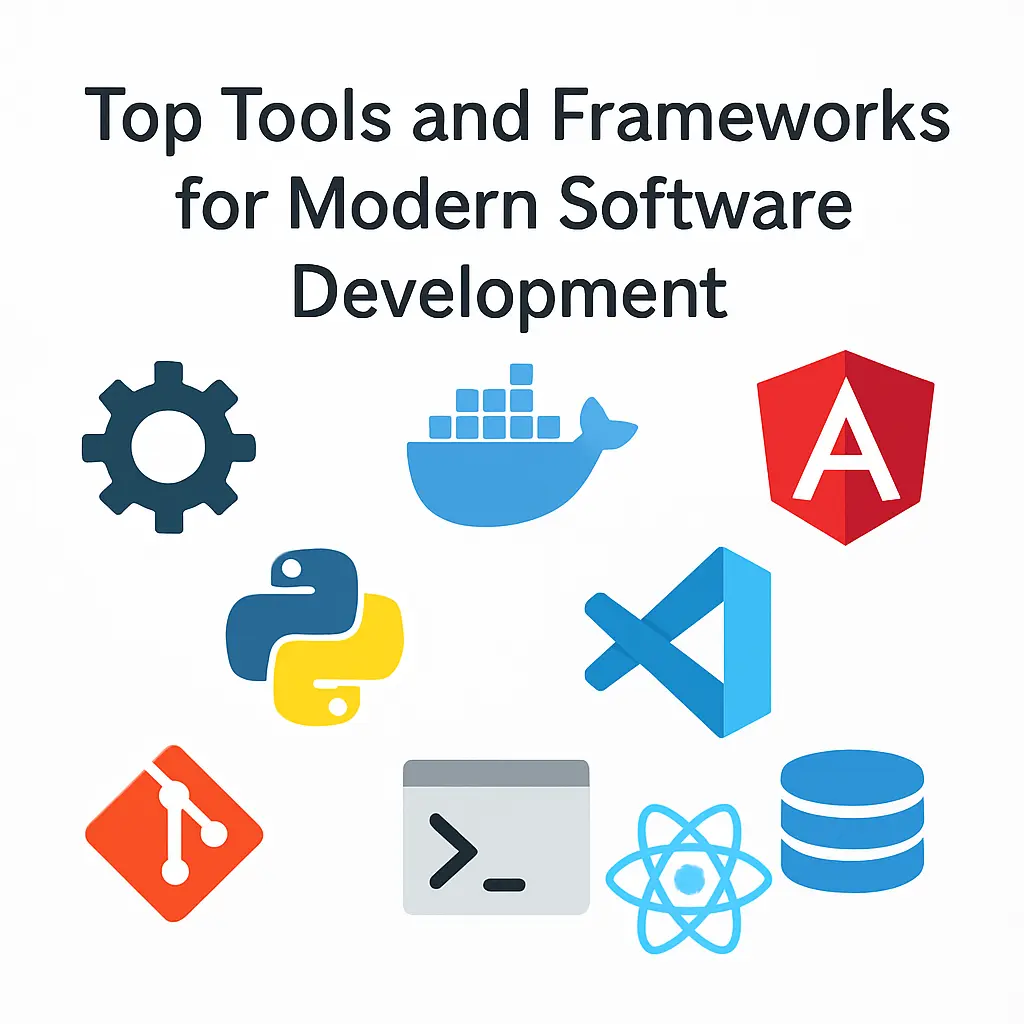
Choosing from the many available options can be difficult, which is why comparative resources are useful when evaluating ecosystems. For broader perspective on widely adopted stacks and development technologies, many teams review guides such as Top Tools and Frameworks for Modern Software Development. Such resources help businesses and developers understand how various categories of tools fit together rather than treating each purchase or implementation decision in isolation.
The key lesson is that modern development success depends on alignment. A powerful framework cannot compensate for weak testing. Fast deployment pipelines do not help if monitoring is poor. Strong collaboration tools still fall short if the application architecture is inconsistent. High-performing teams build systems in which tools and frameworks reinforce each other across the full lifecycle of the product.
How to Choose and Combine the Right Tools and Frameworks
If the first step is understanding the role of modern development technologies, the next step is selecting them wisely. This requires more than following trends. Many teams adopt tools because they are popular, only to discover later that the learning curve, integration burden, or maintenance cost outweighs the benefits. Strategic selection begins with business goals and technical realities, not hype.
A useful starting point is the nature of the product being built. A small internal dashboard, a consumer-facing SaaS platform, an enterprise system, and a real-time data application all have different requirements. Development teams should evaluate tools and frameworks based on performance needs, expected scale, security obligations, developer skill sets, and release frequency. The best stack is not the one with the most features. It is the one that supports the product effectively over time.
Scalability should be examined from two perspectives: system scale and team scale. Some frameworks perform well technically but become difficult to manage when the engineering organization grows. Others provide strong conventions that make collaboration easier across larger teams. If a project is expected to expand significantly, the framework should support modularity, testing, and maintainable patterns that allow many contributors to work productively.
Developer experience is often underestimated, yet it has direct impact on productivity and retention. Tools that are difficult to configure, poorly documented, or fragile in daily use slow down delivery and frustrate teams. On the other hand, tools with clear interfaces, active communities, strong debugging support, and reliable plugin ecosystems reduce friction. When developers can focus more on solving business problems and less on fighting their environment, output improves naturally.
Community support is another practical factor. Widely adopted frameworks often benefit from better documentation, more tutorials, a richer ecosystem of extensions, and more frequent updates. This can reduce implementation risk and make hiring easier. However, popularity should not be the only criterion. Some specialized tools may be better suited to a specific domain even if they serve smaller communities. The important question is whether the ecosystem is healthy, maintained, and trusted.
Long-term maintenance must be part of the decision process. Every added tool increases operational responsibility. Teams must update dependencies, monitor breaking changes, review security advisories, and manage compatibility across environments. A lean toolchain often performs better than a sprawling one. This is why disciplined engineering organizations avoid stacking tools unnecessarily. They prefer solutions that integrate well, solve multiple connected problems, and support sustainable operations.
Integration quality is especially important because development pipelines are interconnected. The code repository should work smoothly with CI systems. The testing framework should fit naturally into the build process. Deployment tools should align with infrastructure management and monitoring. Security scanning should not create so much friction that teams bypass it. A fragmented toolchain creates hidden costs because each handoff introduces complexity and potential failure points.
Governance also matters. In many organizations, tool adoption happens informally, with separate teams choosing their own frameworks and utilities without shared standards. This can accelerate short-term experimentation, but over time it often results in duplication, inconsistent security posture, and costly maintenance. A stronger model combines flexibility with agreed principles. Teams can innovate within boundaries that protect interoperability, compliance, and supportability.
Another important choice is whether to adopt opinionated frameworks or more flexible libraries. Opinionated frameworks provide structure and standard practices, which can speed up onboarding and reduce decision fatigue. They are often well suited for organizations that value consistency and fast execution. Flexible libraries give teams more architectural freedom but demand stronger internal discipline. The right choice depends on team maturity, project complexity, and the level of customization required.
Performance considerations should be approached realistically. Teams sometimes optimize too early by selecting highly specialized tools for problems they do not yet have. In many cases, maintainability and delivery speed create more value than small performance gains. However, for products with heavy traffic, real-time interactions, or large data workloads, performance-oriented frameworks and infrastructure choices can become critical. Good selection requires balancing present needs with credible future demands.
Security and compliance requirements can immediately narrow the field of acceptable technologies. Industries such as finance, healthcare, and government operate under stricter standards for auditing, data handling, access control, and deployment oversight. In these environments, the chosen toolchain must support traceability, policy enforcement, and secure integration patterns. A framework that is convenient for rapid prototyping may be unsuitable for regulated production systems.
Cost should also be assessed beyond licensing. Open-source tools may appear free, but they still require implementation time, training, support, hosting, and maintenance. Commercial platforms may reduce internal effort, but they can create vendor dependency or higher long-term operating expense. Smart evaluation compares total cost of ownership rather than only upfront price. This includes the cost of mistakes if the wrong stack slows development or causes quality issues later.
Migration planning is another sign of mature decision-making. Many organizations are not choosing tools for a brand-new project. They are modernizing legacy systems. In that situation, the ideal future-state framework is only part of the equation. Leaders also need to consider interoperability, phased migration, data transition, and the ability to maintain current operations during change. The best modernization strategy is often incremental rather than disruptive.
Training and internal adoption should never be treated as afterthoughts. Even excellent tools fail when teams do not understand how to use them well. Successful adoption includes documentation, coding standards, onboarding materials, and opportunities for developers to share lessons learned. A framework becomes valuable only when it is used consistently and with skill. Organizations that invest in enablement tend to gain more lasting value from their technology choices.
Measurement is what turns tool adoption from assumption into evidence. Teams should define what success looks like before implementation. Useful indicators may include deployment frequency, lead time for changes, failure recovery time, defect rates, onboarding speed, system reliability, and developer satisfaction. These measures reveal whether the selected tools and frameworks are truly improving outcomes or merely changing workflows without meaningful benefit.
As organizations refine their stacks, they often compare categories such as front-end frameworks, API platforms, testing suites, automation servers, and observability systems. Broader overviews like Top Tools and Frameworks for Modern Software Development can support this evaluation by showing how key technologies are typically used together in modern environments. This kind of perspective is especially helpful when building a cohesive stack rather than making isolated technical purchases.
Ultimately, the most effective toolchain is not the most fashionable one. It is the one that enables a team to design clearly, build efficiently, test confidently, deploy safely, monitor continuously, and improve steadily. Tools and frameworks should reduce friction, not create it. When chosen with discipline and aligned to business priorities, they become multipliers of quality and speed rather than sources of technical noise.
The broader trend in software development points toward integrated ecosystems where automation, visibility, security, and maintainability are built into the process from the beginning. Businesses that understand this are better positioned to release features faster, adapt to changing user needs, and scale with fewer operational surprises. The decisions made around tools and frameworks today shape not only how software is built, but how effectively it evolves in the future.
Modern software development depends on more than writing code quickly; it requires connected frameworks, reliable tools, and deliberate choices that support the full product lifecycle. By selecting technologies based on business goals, team capabilities, scalability, and long-term maintainability, organizations can build stronger systems. For readers, the takeaway is clear: choose tools strategically, integrate them thoughtfully, and let them serve sustainable software growth.