Modern software development moves fast, and teams are expected to deliver secure, scalable, and user-friendly products without sacrificing quality. Choosing the right tools and frameworks is no longer a technical detail; it is a strategic decision that shapes productivity, collaboration, and long-term maintainability. This article explores how modern development stacks are selected, how they affect delivery, and what businesses and engineers should evaluate before committing.
Building a Modern Development Foundation
Software development today is not defined by a single programming language or one dominant framework. Instead, successful products are built on ecosystems: front-end frameworks, back-end platforms, testing libraries, cloud services, version control systems, package managers, and deployment pipelines all work together. Because of this, the phrase “best tool” has become less useful than “best-fit toolchain.” The most effective development teams do not simply chase trends. They evaluate how each piece of their stack contributes to speed, reliability, security, and adaptability.
The first important shift in modern development is the move from monolithic thinking to modular thinking. In the past, teams often chose one large platform and built everything around it. Today, modular architectures allow organizations to select specialized tools for separate responsibilities. A JavaScript framework may drive the user interface, while a Python or Node.js service powers APIs, and cloud-native infrastructure handles scaling and availability. This approach creates flexibility, but it also raises the stakes of integration and compatibility. A good stack is not just individually strong; it must also be coherent as a whole.
Front-end frameworks illustrate this clearly. Users now expect seamless interfaces, real-time updates, accessibility, responsive design, and app-like performance across devices. Frameworks such as React, Vue, and Angular remain central because they help developers organize complex interfaces into reusable components and maintain state more effectively. However, the choice among them should depend on project scope, team expertise, and long-term maintenance plans. React offers a vast ecosystem and high flexibility, Vue is often praised for approachability and elegant structure, and Angular provides a highly opinionated architecture that can benefit large enterprise applications. None is universally superior; each serves different needs.
Back-end frameworks present a similar pattern. On the server side, decisions often revolve around development speed, scalability, security, and ecosystem maturity. Express and NestJS are popular in JavaScript and TypeScript environments because they support API development and microservices efficiently. Django remains a strong choice for teams that value convention, built-in security practices, and rapid development. Laravel is favored for readable PHP development and a rich ecosystem. Spring Boot continues to lead in enterprise Java contexts where robustness, structure, and long-term support matter. The deeper point is that framework selection should reflect both technical and organizational realities. If a team lacks expertise in a powerful but complex stack, delivery may suffer despite the tool’s capabilities.
Another major layer in the modern foundation is version control and collaboration. Git has become the standard not simply because it stores code history, but because it enables workflows that support distributed teams, code review, rollback, branching strategies, and release discipline. Platforms such as GitHub, GitLab, and Bitbucket are not just repositories; they are collaboration hubs where development, issue tracking, documentation, and automation increasingly converge. This convergence matters because modern software development is no longer a linear handoff from coder to tester to operations team. It is a continuous cycle of planning, building, validating, deploying, and monitoring.
Testing tools are equally essential in a stack that aims for speed without compromising quality. Automated testing has moved from being a best practice to being a baseline requirement. Unit testing frameworks such as Jest, Mocha, JUnit, or Pytest help validate core logic early. Integration testing ensures services interact correctly. End-to-end tools like Cypress and Playwright simulate real user behavior and catch regressions before users do. The strategic value of testing tools lies in confidence. Teams that trust their test suites can refactor more aggressively, release more frequently, and recover from change more safely. In contrast, teams with weak testing often become slower over time because every update feels risky.
Containerization and orchestration have also reshaped what a “modern” toolchain looks like. Docker allows applications to run in consistent environments across development, testing, and production. Kubernetes extends this by managing deployment, scaling, failover, and service discovery at scale. These technologies are not mandatory for every project, but they are transformative when complexity grows. Their real value is not only in technical portability, but in operational predictability. When environments are standardized, teams waste less time debugging configuration issues and more time delivering product value.
Cloud platforms deserve special attention because they increasingly influence framework and tooling choices. AWS, Azure, and Google Cloud offer databases, storage, serverless functions, AI services, observability tools, and security controls that can reduce the need to build infrastructure from scratch. Yet cloud convenience must be balanced against cost control, vendor lock-in, and architectural discipline. Teams that adopt cloud-native services thoughtfully can accelerate delivery significantly. Teams that adopt them impulsively may create expensive, fragmented systems that become difficult to govern.
One useful way to think about modern development tools is to divide them into categories of value:
- Productivity tools that reduce development time, such as frameworks, IDEs, code generators, and package ecosystems.
- Quality tools that protect reliability, including testing frameworks, linters, static analysis, and security scanners.
- Operational tools that support deployment and scaling, such as Docker, Kubernetes, CI/CD platforms, and observability services.
- Collaboration tools that coordinate teams, including Git platforms, documentation systems, sprint planning tools, and communication workflows.
These categories overlap, and that overlap is exactly why stack decisions matter so much. A front-end framework influences testing choices. A back-end language affects cloud integrations. CI/CD pipelines depend on repository structure and deployment patterns. Security scanners tie into package management and build automation. A modern development environment is a system, not a menu of isolated parts.
Businesses evaluating new stacks often focus too heavily on immediate velocity. Fast onboarding and rapid prototyping are valuable, but they are only part of the equation. Long-term maintainability can be even more important. A framework with strong documentation, broad community support, mature plugins, and stable update paths may outperform a trendier alternative over several years. Hiring is another factor. A company that chooses a niche stack may face recruitment bottlenecks or higher training costs. The smartest technical choices usually sit at the intersection of engineering excellence, business needs, and team capability.
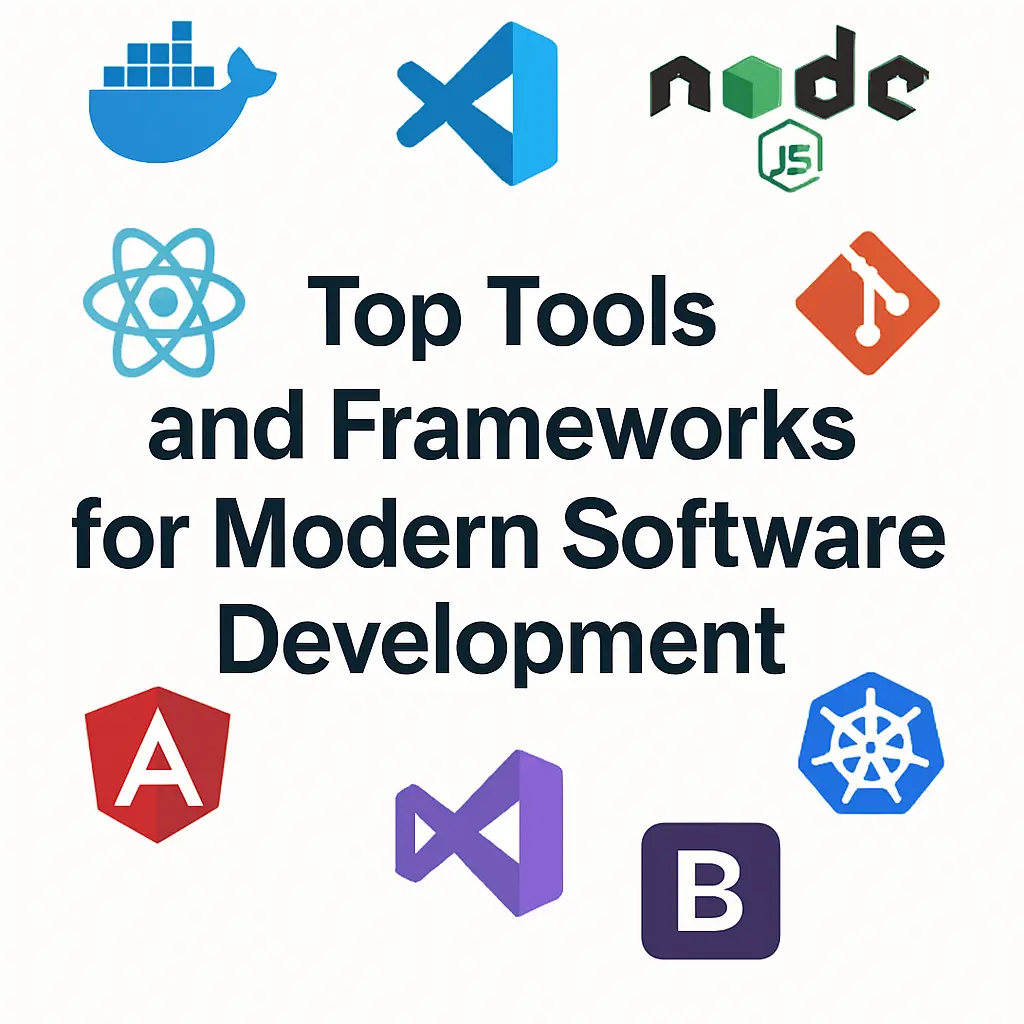
For readers who want a broader look at current ecosystem options, Top Tools and Frameworks for Modern Software Development offers another perspective on the technologies shaping modern engineering teams.
Choosing, Integrating, and Scaling the Right Toolchain
Once the foundation is understood, the next challenge is selection. Teams often ask, “Which framework should we use?” but the better question is, “What constraints and goals should our toolchain support?” A startup validating a product idea may prioritize speed, low operational overhead, and rapid iteration. An enterprise handling sensitive data may prioritize auditability, security controls, compliance, and structured governance. A media platform expecting unpredictable traffic spikes may emphasize scalability and performance under load. The same tool can be excellent in one context and problematic in another.
A practical decision process begins with architecture. Before choosing frameworks, a team should define whether the product is likely to remain relatively simple or evolve into a distributed system. A single deployable application may be easier to build and manage at first, while service-oriented approaches may become useful as domains and teams grow. Frameworks should support the intended architectural direction without forcing unnecessary complexity. It is often a mistake to adopt advanced orchestration or microservices patterns too early. Overengineering can slow a project just as surely as underengineering can destabilize it.
Performance is another major decision factor, but it must be interpreted carefully. Benchmark figures can be misleading if they are detached from actual user experience or workload patterns. A framework that wins in raw throughput may still be a poor fit if it slows development, complicates debugging, or lacks ecosystem support. Modern software success usually depends on balanced performance: acceptable speed for users, efficient workflows for developers, and sustainable operations for the business. This is why mature teams evaluate total cost of ownership rather than isolated technical metrics.
Security should be embedded in the selection process rather than added after launch. Frameworks with strong security defaults, active maintenance, and transparent vulnerability management reduce exposure significantly. Dependency management is especially important because modern applications often rely on hundreds or thousands of third-party packages. Tools such as Snyk, Dependabot, and various static application security testing systems help identify risks early, but they are only effective when integrated into development routines. Security in modern software development is not a single tool; it is a stack-wide discipline supported by automation and governance.
Developer experience has become one of the most underrated factors in stack decisions. A framework may be technically excellent yet frustrating in daily use. Slow build times, opaque configuration, poor error messages, and confusing documentation all erode productivity. Conversely, tools that provide clear structure, good debugging support, strong editor integration, and fast feedback loops can improve output dramatically. Since software is built by people, the usability of the development environment deserves serious attention. Better developer experience often results in better product quality because teams spend less energy fighting tooling and more energy solving user problems.
This leads naturally into CI/CD, a defining feature of modern software operations. Continuous integration ensures that code changes are merged, built, and tested frequently, reducing integration risk. Continuous delivery or deployment extends this by automating release workflows so software can move to production faster and more safely. Tools like GitHub Actions, GitLab CI, Jenkins, CircleCI, and Azure DevOps differ in flexibility, complexity, and ecosystem fit, but they all aim to create reliable automation. The key value of CI/CD is not speed alone. It is consistency. Automated pipelines reduce human error, enforce quality gates, and make releases repeatable.
Observability completes the feedback loop after deployment. Building and shipping software is only part of the story; teams also need to understand how systems behave in production. Logs, metrics, traces, and real-user monitoring reveal whether applications are healthy, fast, and dependable. Tools such as Prometheus, Grafana, Datadog, New Relic, and OpenTelemetry help teams detect bottlenecks, diagnose incidents, and optimize performance over time. Without observability, even a well-built stack becomes reactive because teams only learn about failures after users complain. With observability, development becomes evidence-driven.
As teams scale, internal standards become more important than individual tool choices. Two companies can use the same technologies and still achieve very different outcomes depending on governance. Coding conventions, documentation practices, branching models, API standards, dependency policies, and release procedures all influence how effective a toolchain becomes. Standardization should not eliminate flexibility, but it should reduce unnecessary variation. If every project uses a different testing strategy, deployment model, or package structure, maintenance costs rise and knowledge becomes siloed. Strong engineering organizations create paved roads: recommended patterns that accelerate teams while preserving room for justified exceptions.
Technical debt must also be part of any serious discussion about frameworks and tools. Every choice has a lifecycle. Some tools age well because they are actively maintained, stable, and backed by large communities. Others become brittle due to weak support, rapid breaking changes, or ecosystem fragmentation. Managing debt means revisiting stack decisions regularly, monitoring upgrade paths, and refactoring before outdated dependencies become business risks. The goal is not constant replacement. It is intentional evolution. Modern software development succeeds when systems can absorb change without requiring total rewrites.
Teams can use the following criteria when evaluating tools and frameworks:
- Project fit: Does the tool match the application’s scale, complexity, and domain requirements?
- Team fit: Does the current team have the skills to use it effectively, or is training realistic?
- Ecosystem maturity: Is documentation strong, community support active, and long-term maintenance credible?
- Integration potential: Will it work smoothly with testing, deployment, security, and monitoring workflows?
- Operational impact: How does it affect infrastructure complexity, reliability, and cost?
- Future resilience: Does it allow the product to evolve without excessive migration pain?
A common mistake is treating framework selection as a one-time technical event rather than an ongoing strategic capability. The best organizations build an evaluation culture. They prototype, benchmark relevant scenarios, gather feedback from developers, assess maintenance implications, and review decisions as products evolve. This prevents dogmatism and encourages practical thinking. It also helps organizations avoid extreme positions, such as blindly adopting every new tool or refusing all change in favor of outdated stacks.
There is also growing interest in platform engineering and internal developer platforms. As toolchains become more complex, many organizations create shared infrastructure layers that simplify deployment, security, and environment management for application teams. Instead of every team configuring CI/CD, observability, and cloud resources independently, a platform team provides reusable templates and services. This can dramatically improve consistency and productivity. However, platform engineering succeeds only when it serves developer needs rather than imposing rigid abstractions detached from real workflows.
Artificial intelligence is becoming another meaningful component of modern development environments. AI-assisted coding tools can help generate boilerplate, suggest tests, explain unfamiliar code, and support debugging. Used carefully, they can improve productivity. But they do not replace engineering judgment, architectural reasoning, or code review discipline. In fact, as AI-generated code becomes more common, strong testing, security review, and maintainability standards become even more important. AI should be considered an accelerator inside a mature toolchain, not a substitute for one.
For additional reading on stack selection and ecosystem comparisons, see Top Tools and Frameworks for Modern Software Development, which expands on many of the technologies teams consider when building modern applications.
Ultimately, the strongest software teams understand that tools and frameworks are multipliers. When chosen well, they amplify talent, streamline collaboration, and support sustainable delivery. When chosen poorly, they create friction, lock teams into costly patterns, and slow progress over time. The real objective is not to assemble the most fashionable stack. It is to create an environment where developers can build secure, scalable, maintainable software with confidence and speed.
Modern software development depends on more than individual frameworks; it relies on a connected toolchain that supports architecture, collaboration, testing, deployment, security, and observability. The best choices come from aligning technology with business goals, team skills, and future growth. Readers should view stack decisions as long-term investments: evaluate carefully, integrate thoughtfully, and choose tools that make both delivery and evolution more sustainable.