Software teams are under constant pressure to ship features faster without sacrificing reliability, security, or user experience. This article explores how modern engineering practices help organizations accelerate delivery while maintaining stability. We will look at the foundations of efficient .NET development, then connect them to release strategies that reduce risk, improve uptime, and support continuous improvement across the entire software lifecycle.
Building the foundation for faster and safer delivery in .NET
Speed in software delivery is often misunderstood. Many organizations treat it as a matter of developer output alone, assuming that faster coding automatically leads to faster releases. In practice, sustainable speed comes from system design, team workflow, architecture, testing discipline, deployment automation, and feedback loops. For .NET teams in particular, faster delivery is not only about mastering the language or framework. It is about creating a technical and operational environment where change can move from idea to production with minimal friction and minimal risk.
A strong delivery foundation begins with codebase structure. Large, tightly coupled applications slow everything down. They are harder to test, more dangerous to change, and more expensive to deploy. A modular design, by contrast, enables teams to isolate functionality, contain defects, and update services or components without destabilizing the whole system. In the .NET ecosystem, this often means clear separation of concerns, thoughtful API boundaries, dependency injection used with discipline, and architectures that support independent evolution rather than accidental complexity.
Equally important is standardization. Teams that deliver rapidly tend to have consistent approaches to project structure, naming conventions, logging, configuration, and environment management. Standardization reduces cognitive load. Developers spend less time decoding patterns and more time improving the product. It also helps automate repetitive tasks because predictable systems are easier to validate, build, and deploy. This is one reason many engineering leaders prioritize shared templates, reusable libraries, and common pipelines across .NET projects.
Performance also influences delivery speed more than many teams expect. Slow local builds, long test runs, and heavy startup times create invisible drag on developer productivity. If every change requires a long wait before validation, context switching increases and the pace of iteration drops. Modern .NET development emphasizes build optimization, parallelized testing, container-friendly setups, and tooling that supports rapid feedback. The goal is not merely technical elegance but operational efficiency: every minute saved in the inner development loop compounds across teams and release cycles.
Testing strategy is another critical lever. Fast delivery does not mean reducing quality controls. It means making quality checks more reliable, more targeted, and more automated. A balanced strategy includes unit tests for logic, integration tests for service interaction, contract tests where dependencies matter, and end-to-end tests used selectively for business-critical flows. Too few tests increase production risk. Too many poorly designed tests create noise, maintenance burden, and pipeline delays. Effective .NET teams refine their test pyramid continuously so they can move quickly with confidence.
Observability should be treated as part of development, not only as an operations concern. Rich logging, distributed tracing, meaningful metrics, and actionable alerts are essential to fast delivery because they shorten the time between failure and understanding. If a deployment introduces latency, memory growth, or unexpected exceptions, teams need visibility immediately. Modern applications built on .NET often run in distributed or cloud-native environments, where hidden dependencies and asynchronous behavior make troubleshooting harder. Observability turns production from a black box into a source of fast feedback, allowing teams to detect problems before users are widely affected.
Security also has a direct relationship with delivery speed. When security checks happen late, releases stall. When security is integrated early, delivery becomes more predictable. Dependency scanning, secret management, secure defaults, access controls, and code analysis should be woven into the development lifecycle. In regulated or enterprise contexts, this integration prevents painful approval bottlenecks near release time. It also helps teams avoid the false choice between speed and safety. Mature delivery organizations understand that secure systems are easier to release because they inspire trust across engineering, operations, compliance, and business stakeholders.
Cloud alignment matters as well. Modern .NET applications increasingly rely on containers, orchestration platforms, managed databases, and scalable infrastructure services. Delivery pipelines should reflect this reality. Environments should be reproducible. Configuration should be externalized. Infrastructure should be provisioned in versioned, reviewable ways. These practices reduce the classic “works on my machine” problem and make releases more deterministic. The less uncertainty exists between development, staging, and production, the less friction teams experience when promoting changes.
All of these principles point toward a broader truth: fast software delivery is an organizational capability, not a single tool or framework feature. Teams improve speed by reducing waste, creating reliable feedback loops, and making change safer. For readers looking for a practical view on improving engineering flow and aligning .NET practices with business speed, Modern NET Development Tips for Faster Software Delivery provides a useful complementary perspective on the daily disciplines that support rapid, high-quality execution.
Once this foundation is in place, a team reaches an important threshold. It becomes easier not only to build software quickly but also to release it intelligently. That shift matters because development speed alone has limited value if deployment remains risky, manual, or disruptive. This is where release engineering becomes the natural continuation of modern development practice.
Release strategies that protect uptime while enabling continuous change
As delivery maturity increases, the challenge changes from “How do we ship faster?” to “How do we ship faster without breaking user trust?” In digital products, reliability is part of the brand. Users expect services to be available, responsive, and consistent even while improvements are being introduced. Traditional deployment approaches, where a full update is pushed to all users at once during a maintenance window, are often too risky for systems that operate continuously. Modern release strategies solve this problem by controlling exposure, validating behavior in production, and making rollback easier.
Zero-downtime deployment is best understood as a business capability rather than a purely technical trick. It protects revenue, customer satisfaction, employee productivity, and operational reputation. But achieving it requires preparation. Applications must tolerate multiple versions coexisting briefly. Databases need change strategies that support compatibility during transitions. Session management, caching behavior, message contracts, and configuration changes must be planned carefully. A deployment strategy is only as strong as the application design and operational discipline behind it.
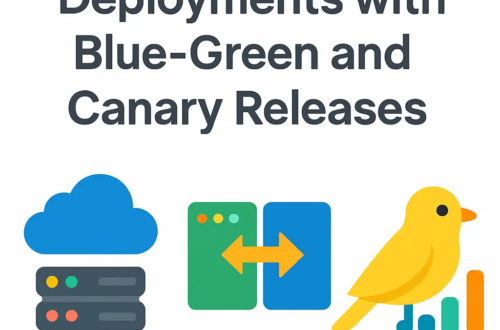
Among the most effective release models are blue-green deployments and canary releases. Both reduce production risk, but they do so in different ways. Blue-green deployment relies on maintaining two production-ready environments. One environment serves current users while the other receives the new version. After validation, traffic is switched from the old environment to the new one. The major advantage is simplicity in rollback: if a critical issue appears, traffic can be redirected back quickly. This approach is especially useful for applications where predictable cutover and rapid reversal are more important than gradual exposure.
Canary releases take a more incremental approach. Instead of switching everyone to the new version at once, the release is exposed to a small subset of users or traffic first. Teams monitor behavior closely, comparing error rates, response times, business conversions, and infrastructure signals. If the release performs well, exposure increases in stages. If not, the rollout stops or reverses before the majority of users are affected. Canary release is powerful because it transforms deployment into a controlled experiment. It gives real production feedback under limited risk.
Choosing between these strategies depends on application architecture, risk tolerance, operational tooling, and business context. Blue-green deployment can be easier to reason about operationally when full-environment duplication is practical. Canary release can be more efficient when gradual rollout and targeted validation are priorities. In some organizations, both are used together: a team deploys to a green environment, validates it internally, and then introduces traffic gradually in canary phases. What matters most is not the label of the strategy but the discipline of controlled change.
One common mistake is assuming that deployment strategy alone guarantees safety. In reality, zero-downtime releases depend on compatibility planning. Database changes are often the hardest part. If a new application version requires a schema change that breaks the old version immediately, blue-green or canary techniques lose much of their protection. Mature teams therefore design database migrations in phases: add new structures first, deploy application changes that can work with both old and new formats, backfill if needed, and remove legacy structures only after the system has stabilized. This backward-compatible approach is essential for seamless transitions.
Feature flags also play a central role in modern releases. They separate deployment from feature exposure. A team can deploy code to production without enabling the user-facing behavior immediately. This reduces pressure during release windows and allows more precise control over who sees what and when. Flags support staged rollouts, internal testing in production, A/B experiments, and rapid deactivation if a feature misbehaves. However, they must be managed carefully. Uncontrolled flag growth can create hidden complexity, branching logic, and maintenance risk. The best teams treat flags as temporary operational tools with clear ownership and retirement policies.
Monitoring during rollout must be intentional, not reactive. Before deployment begins, teams should define what success and failure look like. Technical indicators might include latency, memory usage, throughput, queue depth, and exception frequency. Business indicators might include checkout completion, sign-in success, session length, or support ticket volume. The key is to connect technical changes to user impact. A release can look healthy from an infrastructure perspective while still damaging a critical business flow. Release decisions should be informed by both categories of signal.
Automation is what turns release strategy from a heroic practice into a repeatable one. Manual deployments can work occasionally, but they do not scale well and they invite inconsistency. Automated pipelines should build artifacts once, promote the same artifact across environments, run validation checks, apply policy gates, and execute rollout steps in a documented manner. Automation should also support rollback paths, environment verification, smoke tests, and notifications. In .NET environments, this often means combining CI/CD workflows with infrastructure definitions, container registries, cloud deployment services, and observability platforms in a cohesive system.
There is also a cultural aspect to safe releases. Teams that deploy well tend to learn continuously from incidents, near misses, and successful rollouts. They use post-incident reviews not to assign blame but to strengthen systems. If a canary caught a defect early, they ask what made that possible and how to improve detection further. If a blue-green cutover failed because of a hidden dependency, they address the dependency, not just the immediate symptom. Over time, this learning culture creates resilience. Deployment stops being feared and becomes a normal, well-understood part of delivery.
For customer-facing systems, zero-downtime strategies also have competitive value. Frequent, low-risk releases let businesses respond faster to market opportunities, legal requirements, user feedback, and security threats. Instead of bundling many changes into rare, high-stakes releases, teams can deliver smaller increments continuously. Smaller changes are easier to test, easier to understand, and easier to reverse. This reduces blast radius and improves forecasting. In practice, operational excellence becomes a growth enabler, not just a technical hygiene factor.
It is equally important to recognize the role of organizational alignment. Product managers, developers, QA specialists, security teams, and operations engineers should share a common release language. If product expects instant launches, engineering needs the freedom to use staged rollouts. If compliance requires auditability, pipelines should provide traceability automatically. If support teams need awareness of feature exposure, rollout plans should be communicated in advance. Strong release strategies succeed when they are integrated into the broader business process, not handled as an isolated infrastructure concern.
Teams ready to deepen their understanding of controlled production releases should study practical approaches such as Zero Downtime Deployments with Blue Green and Canary Releases. These methods become especially valuable when paired with modern .NET development practices, because engineering speed and release safety reinforce each other. The stronger the development foundation, the easier it is to deploy frequently. The stronger the deployment process, the more confidently teams can invest in continuous delivery.
Ultimately, the relationship between modern development and zero-downtime release strategy is direct and strategic. Clean architecture, automation, observability, compatibility planning, and disciplined testing create the preconditions for safe change. Blue-green and canary methods then operationalize that change in production with minimal user disruption. Together, they form a delivery model that is both fast and trustworthy, which is exactly what modern software businesses need in order to compete sustainably.
Modern software delivery succeeds when development discipline and release strategy work as one system. Efficient .NET practices reduce friction in coding, testing, and automation, while blue-green and canary releases minimize deployment risk and protect uptime. Organizations that invest in both can ship smaller changes more often, learn faster from production, and build user trust through reliability as well as innovation.