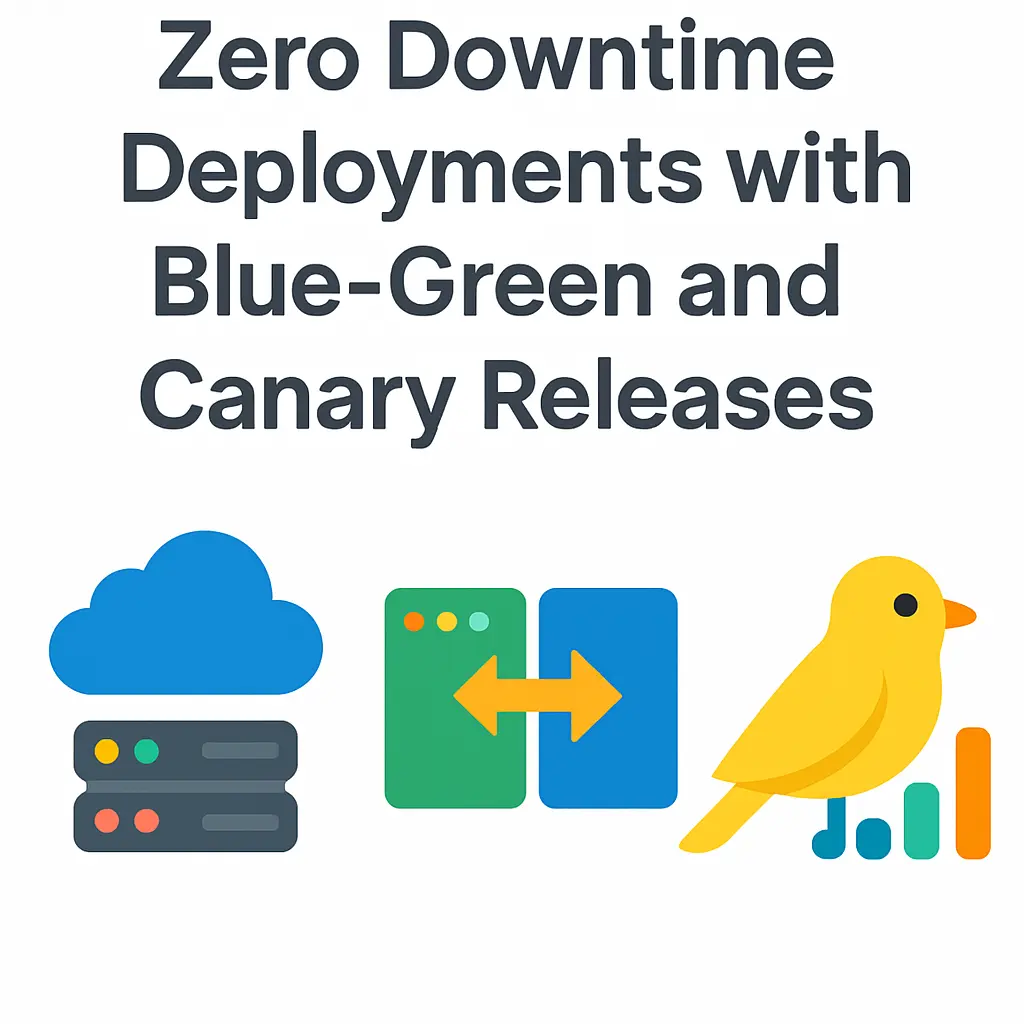
Modern users expect software to improve continuously without interruptions, failed sessions, or maintenance windows. This article explains how zero-downtime deployment strategies make that possible, with special focus on blue-green deployments and canary releases. We will examine how they work, when to use them, what risks they reduce, and how teams can implement them reliably in real production environments.
Understanding Zero-Downtime Deployment Foundations
Zero-downtime deployment is the practice of releasing new application versions without making the service unavailable to users. Instead of stopping the old version, replacing files, restarting servers, and hoping everything works, modern deployment pipelines keep traffic flowing while changes are introduced gradually or switched over safely. This approach is especially important for SaaS platforms, e-commerce websites, financial systems, healthcare applications, APIs, and any product where interruption directly affects revenue, trust, or user experience.
The traditional deployment model often assumes that downtime is acceptable if it is short and announced in advance. That may have worked for internal systems or small websites, but it does not fit today’s global digital environment. Users access applications from many time zones, mobile devices remain connected constantly, and automated clients may depend on APIs every second. Even a five-minute outage can break workflows, abandon shopping carts, interrupt payments, or trigger alerts for enterprise customers.
Zero-downtime deployment is not a single tool or command. It is a combination of architecture, infrastructure, automation, monitoring, testing, rollback planning, and release discipline. The goal is to separate the act of deploying code from the act of exposing that code to all users. When those two actions are separated, teams gain control. They can install new versions, validate them, route limited traffic, observe metrics, and reverse quickly if something goes wrong.
Two of the most widely used strategies are blue-green deployments and canary releases. Both aim to reduce risk, but they do so differently. Blue-green deployment relies on maintaining two production-like environments. One environment serves current users while the other receives the new version. Once the new version is verified, traffic is shifted from the old environment to the new one. Canary deployment, by contrast, introduces the new version to a small percentage of traffic first, then expands exposure gradually if results are healthy.
A good zero-downtime strategy begins with application readiness. The software must support multiple versions running at the same time, at least for a short period. This means database changes must be backward compatible, APIs should not break existing clients suddenly, and background jobs must handle version overlap. A deployment may be technically smooth at the infrastructure level but still fail if the application assumes that only one version can exist at once.
Database migrations are often the most difficult part. Code can be swapped or scaled easily, but databases are shared state. A risky migration that renames a column, deletes a table, or changes data format can break the older application while the new one is being deployed. For zero downtime, teams often use an expand-and-contract pattern. First, they add new structures without removing old ones. Then both old and new versions work safely. After all traffic moves to the new version and stability is confirmed, obsolete fields or tables are removed in a later deployment.
Infrastructure also matters. Load balancers, container orchestration platforms, service meshes, and cloud routing tools make controlled traffic switching possible. Health checks must be accurate, not superficial. A server that responds to a basic ping may still be unable to connect to the database, process messages, or serve real user requests. Strong readiness and liveness checks help ensure that traffic only reaches instances that can truly handle it.
For a broader overview of practical deployment patterns, teams often study resources such as Zero-Downtime Deployments with Blue-Green and Canary, because these strategies are easier to understand when viewed as part of a complete release workflow rather than as isolated infrastructure tricks.
Monitoring is another foundation. Zero downtime is not only about avoiding visible outages; it is also about detecting hidden degradation before it becomes widespread. Teams should track technical metrics such as error rates, latency, CPU usage, memory usage, queue depth, and database performance. They should also track business metrics such as checkout completion, signup success, payment approval, search conversion, and user engagement. A deployment that keeps servers online but reduces successful payments is not a successful release.
Finally, zero-downtime deployment requires cultural maturity. Teams must treat releases as controlled operations, not heroic events. This means repeatable pipelines, clear ownership, automated tests, documented rollback steps, and post-deployment reviews. The safest organizations deploy frequently in small increments because smaller changes are easier to understand, test, monitor, and reverse. Ironically, frequent deployment often becomes safer than rare deployment because each release contains fewer surprises.
Blue-Green Deployments and Canary Releases in Practice
Blue-green deployment is one of the clearest zero-downtime models. Imagine two identical environments: blue and green. The blue environment is currently live, handling all production traffic. The green environment is idle or receiving only internal test traffic. The team deploys the new application version to green, runs smoke tests, checks logs, validates integrations, and confirms that the environment behaves like production. When ready, the router or load balancer switches user traffic from blue to green.
The main advantage of blue-green deployment is simplicity at the user traffic level. Instead of slowly mixing versions, teams make a controlled switch. If the new version fails quickly, rollback can be as simple as routing traffic back to the previous environment. This makes blue-green especially useful for applications where a full environment can be duplicated economically and where quick rollback is important.
However, blue-green deployments are not risk-free. If the new version has a defect that appears only under full production load, the problem may affect all users immediately after the switch. That is why pre-switch validation is critical. Teams should test real dependencies, not only mock services. They should warm caches, verify background workers, test authentication flows, and ensure scheduled tasks do not run twice unexpectedly. The inactive environment must be production-like in configuration, permissions, network access, and data connectivity.
Blue-green deployment also requires careful handling of state. Stateless web applications are easier to shift because any healthy instance can serve any request. Stateful applications, long-running sessions, file uploads, WebSocket connections, and in-memory workflows create complexity. To support zero downtime, session data should often be stored externally, uploads should be durable, and clients should tolerate reconnections. If the switch terminates active connections abruptly, users may still experience disruption even if the service technically remains available.
Canary releases take a different approach. Instead of switching everyone at once, a small group of users receives the new version first. For example, the new version may receive 1% of traffic, then 5%, then 20%, then 50%, and finally 100%. At each stage, the team compares metrics between the stable version and the canary version. If errors rise, latency increases, or business metrics decline, the canary is stopped and traffic returns to the stable version.
The canary model is powerful because it limits the blast radius of defects. A bug that affects 1% of users is still serious, but it is far better than affecting everyone. Canary releases are particularly valuable for complex systems, machine learning features, recommendation engines, user interface experiments, and backend changes where behavior under real traffic is difficult to predict perfectly in staging.
Canaries work best when traffic routing is flexible. Teams may route by percentage, geography, tenant, user segment, device type, or internal employee group. Some organizations start with employees, then beta customers, then a small random public cohort. Others choose low-risk regions first. The right approach depends on the product and the consequences of failure. A financial transaction platform may use stricter gates than a content website because user impact differs dramatically.
A canary release must be measured objectively. It is not enough to say, “No one complained.” Many users do not report issues, and some failures happen silently. Teams should define promotion criteria before release. These may include maximum error rate, acceptable latency range, no increase in failed transactions, stable resource consumption, and no unusual log patterns. Automated analysis can compare canary and baseline performance, reducing the chance that human optimism overrides warning signs.
Feature flags often complement canary releases. A feature flag allows a capability to be turned on or off without redeploying code. This gives teams another control layer. The new code may be deployed to production but hidden. Then the feature is enabled for internal users, then selected customers, then broader audiences. If problems occur, the feature can be disabled quickly while the deployed version remains in place.
Blue-green and canary strategies can also be combined. A team might deploy a new version to a green environment, then route only a small percentage of traffic to it as a canary. If the canary passes, traffic gradually increases until green becomes the primary environment. This hybrid model provides the environmental isolation of blue-green with the gradual exposure of canary release. It is often effective for high-traffic systems where both fast rollback and measured rollout are important.
When comparing blue-green and canary releases, the question is not which one is universally better. The better question is which risk profile fits the current change. Blue-green is attractive for clear version switches, infrastructure upgrades, and situations where fast reversal is needed. Canary is better when production behavior is uncertain and gradual learning is valuable. Mature teams often use both, selecting the strategy based on application architecture, customer impact, and operational confidence.
For teams planning to mature their release process, Zero Downtime Deployments with Blue Green and Canary Releases is a useful topic to explore because it connects deployment mechanics with release safety, observability, and user-focused reliability.
Building a Reliable Deployment Workflow from Code to Production
A successful zero-downtime deployment process starts long before production. It begins with how code is written, reviewed, tested, packaged, and promoted. If changes are large, unclear, and poorly tested, no deployment strategy can fully protect users. Blue-green and canary releases reduce operational risk, but they do not replace engineering discipline. The safest releases are small, observable, reversible, and aligned with known user outcomes.
Continuous integration is the first layer. Every change should trigger automated tests that validate core behavior. Unit tests catch isolated logic errors, integration tests verify service boundaries, and end-to-end tests confirm critical workflows. Test suites should prioritize business-critical paths such as login, payment, onboarding, search, account changes, and API contract behavior. The goal is not to test everything perfectly, but to prevent obvious defects from reaching deployment stages.
Build artifacts should be immutable. Once an application version is built, that same artifact should move through staging, pre-production, and production. Rebuilding separately for each environment introduces uncertainty because the production artifact may not be identical to the tested one. Containers, versioned packages, and artifact repositories help teams maintain consistency. Configuration can differ between environments, but the application binary or image should remain the same.
Environment parity is equally important. Staging does not need the same scale as production, but it should resemble production in architecture, dependencies, and configuration patterns. If production uses a real message broker, staging should not rely on a simplified substitute for critical validation. If production uses strict permissions, staging should not run with broad administrative access. Differences between environments are a common source of deployment surprises.
Release pipelines should include automated gates and human decision points where appropriate. For low-risk services, fully automated promotion may be acceptable. For high-risk systems, a deployment may require approval after reviewing test results, security scans, migration plans, and monitoring dashboards. The key is consistency. A release process that changes depending on urgency or individual preference will eventually fail under pressure.
Rollback planning must be explicit. Many teams say they can roll back, but discover during an incident that rollback is blocked by database changes, incompatible messages, cache pollution, or irreversible external actions. A reliable rollback plan identifies what can be reversed, what cannot, and what mitigation is available. Sometimes the better option is not rollback but roll-forward: deploying a quick fix that restores behavior while keeping the new architecture intact.
Backward compatibility is one of the strongest principles in zero-downtime deployment. APIs should support old and new clients during transition periods. Events and messages should include versioning or tolerant consumers. Database schemas should allow older and newer application versions to run simultaneously. Removing compatibility too early creates fragile deployments. Teams should treat compatibility as a temporary bridge that is removed only after traffic, clients, and data have safely migrated.
Observability should be designed into the system, not added during incidents. Logs should include version identifiers so teams can compare behavior between old and new releases. Metrics should be tagged by deployment version, region, service, endpoint, and customer segment where useful. Distributed tracing helps reveal whether latency comes from the application, database, cache, third-party service, or network. Without version-aware observability, canary analysis becomes guesswork.
Incident response also belongs in the deployment workflow. If a release causes problems, the team should know who decides whether to pause, roll back, disable a feature flag, or continue monitoring. Communication channels should be clear. Customer support should know when a release is happening and what symptoms users may report. A technical rollback may happen in minutes, but poor communication can extend customer frustration much longer.
Security and compliance should not be ignored in zero-downtime strategies. Duplicated environments in blue-green deployments must both be secured, patched, and monitored. Canary cohorts must not accidentally expose sensitive features to unauthorized users. Feature flags should have access controls and audit trails. Deployment speed is valuable, but it should not bypass governance, especially in regulated industries.
Cost is another practical factor. Blue-green deployment may require double infrastructure capacity, at least temporarily. For large systems, that can be expensive. Cloud autoscaling, container scheduling, and temporary capacity planning can reduce waste, but teams should understand the tradeoff. Canary releases may be more cost-efficient because they often use the same cluster with controlled routing, but they may require more sophisticated observability and traffic management.
Teams should also avoid treating zero downtime as an absolute guarantee. Network failures, cloud provider incidents, unexpected data corruption, third-party outages, and human mistakes can still happen. The realistic goal is to minimize planned downtime and reduce release-related incidents. Mature organizations measure deployment frequency, change failure rate, mean time to recovery, and user impact. These metrics reveal whether the deployment process is actually improving.
A practical implementation roadmap may look like this:
-
Start with health checks and load balancing. Ensure traffic only reaches instances that are ready to serve real requests.
-
Automate tests and builds. Create repeatable pipelines that reduce manual errors and inconsistent release steps.
-
Make database changes backward compatible. Use phased migrations instead of destructive schema changes during deployment.
-
Add feature flags. Separate deployment from feature exposure and create a fast mitigation path.
-
Introduce blue-green for suitable services. Practice switching and rolling back before using it for critical releases.
-
Adopt canary releases for higher-risk changes. Define metrics and promotion rules before exposing users.
-
Review every release. Learn from near misses, slow rollbacks, noisy alerts, and unclear ownership.
The deepest value of zero-downtime deployment is not merely technical uptime. It changes how a company delivers software. Teams become more confident because releases are routine rather than frightening. Product managers can ship improvements faster. Customers receive value without disruption. Engineers spend less time coordinating maintenance windows and more time improving reliability. The organization moves from risky release events to continuous, controlled delivery.
Conclusion
Zero-downtime deployment is built on careful architecture, automation, monitoring, and disciplined release habits. Blue-green deployments provide clean environment switching, while canary releases offer gradual exposure and safer learning from real traffic. Used thoughtfully, these strategies reduce outages, protect users, and help teams deliver improvements continuously. The best approach is the one that matches your system’s risk, scale, and operational maturity.