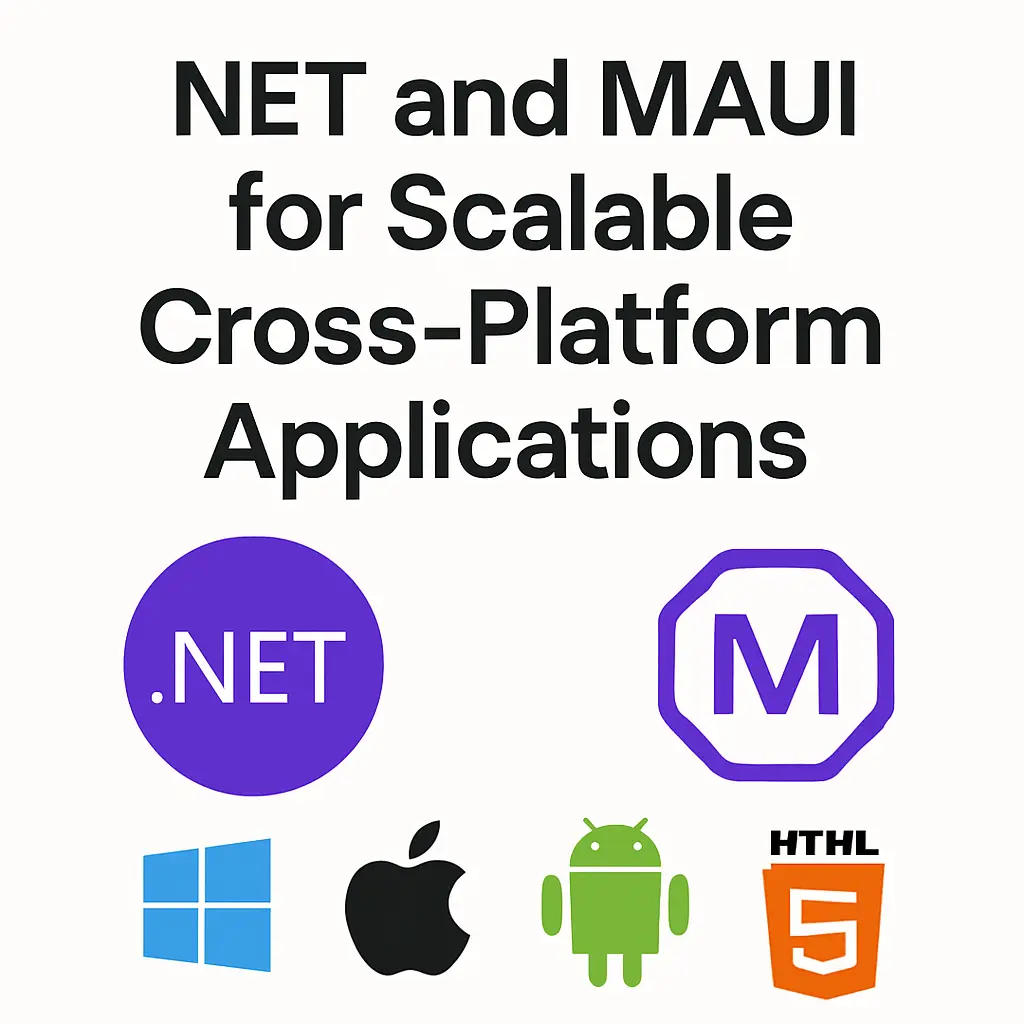
.NET and MAUI: together they form a powerful foundation for building modern, scalable, and cross-platform applications. In this article, we will explore how .NET fits into today’s software landscape, why businesses choose it for mission-critical solutions, and how .NET MAUI extends that power into native mobile and desktop experiences with a single codebase.
The Strategic Value of .NET in Modern Software Development
.NET has evolved far beyond its origins as a Windows-only framework. Today, it is a unified, open-source, cross-platform ecosystem capable of supporting cloud-native systems, high-performance web backends, enterprise integrations, and sophisticated desktop and mobile apps. Its maturity, tooling, and performance characteristics make it a strategic choice for organizations planning long-term digital investments.
At the core of .NET’s appeal is its combination of developer productivity and runtime efficiency. Features like a rich base class library, strong typing, asynchronous programming support, and powerful debugging tools streamline development. Under the hood, the just-in-time (JIT) compiler, ahead-of-time (AOT) options, and runtime optimizations deliver high performance even under heavy workloads.
From a business standpoint, .NET reduces development risk. There is a large pool of experienced developers, strong community support, and long-term commitment from Microsoft. Enterprises can be confident that solutions will be maintainable and supported for years, with regular security updates and performance improvements. When working with specialized net software development services, companies can leverage this ecosystem to design, build, and optimize applications that align precisely with business objectives, regulatory constraints, and growth targets.
Cross-platform reach is now one of .NET’s defining strengths. The same technology stack can power services on Linux servers, applications on Windows desktops, containers in Kubernetes clusters, and logic in serverless functions in the cloud. This consistency greatly simplifies architecture decisions and code reuse, enabling teams to follow a “share as much as possible” philosophy while still respecting platform-specific requirements.
A well-architected .NET solution usually rests on a layered or hexagonal design. Here, domain logic is decoupled from infrastructure, allowing teams to change databases, user interfaces, or deployment models with minimal impact on core business rules. This clean separation is particularly important as organizations move toward microservices or event-driven architectures, where services must be independently deployable and evolvable without breaking the whole system.
Security is another area where .NET provides a robust foundation. Built-in features such as role-based authorization, claims-based authentication, data protection APIs, and first-class integration with identity providers enable developers to implement secure, auditable systems. TLS termination, certificate management, secure storage of secrets, and encryption-at-rest are all part of typical .NET-based architectures, especially in regulated sectors like finance, healthcare, or government.
Scalability considerations in .NET systems often guide architectural choices. For web backends using ASP.NET Core, non-blocking I/O, connection pooling, caching strategies, and efficient use of asynchronous operations allow the same infrastructure to handle significantly more traffic. When combined with cloud-native practices—containerization, autoscaling, load balancing, circuit breakers, and observability—.NET services can scale horizontally to meet fluctuating demand, such as seasonal peaks or marketing campaigns.
.NET’s compatibility with modern DevOps practices is also crucial. CI/CD pipelines typically include automated builds, unit tests, integration tests, security scanning, and deployment to staging and production environments. Infrastructure-as-code tools like Bicep, Terraform, or ARM templates ensure that environments are consistent and versioned, while monitoring and telemetry are provided via tools like Application Insights, Prometheus, Grafana, or other APM solutions. This feedback loop helps teams catch regression early and continuously improve performance and reliability.
Another often underappreciated advantage is the ecosystem of libraries and frameworks. From ORM tools like Entity Framework Core and Dapper to messaging systems for working with Kafka, RabbitMQ, or Azure Service Bus, the .NET ecosystem helps teams avoid reinventing the wheel. Libraries for logging, validation, background processing, and testing are both numerous and battle-tested, enabling developers to focus on solving business problems rather than low-level plumbing.
Finally, cost efficiency is an important aspect in enterprise decision-making. With .NET being open source and capable of running on Linux, organizations are no longer tied to proprietary OS licensing costs for all workloads. When combined with cloud elasticity, right-sized infrastructure, and performance optimizations, well-designed .NET systems can significantly reduce total cost of ownership over their lifecycle.
Building Unified Cross-Platform Experiences with .NET MAUI
While .NET is a strong foundation for application logic and backend services, modern users expect seamless experiences across phones, tablets, desktops, and sometimes even wearables. .NET Multi-platform App UI (MAUI) addresses this by providing a single framework for building native applications targeting multiple platforms with one shared codebase.
.NET MAUI allows developers to write user interface definitions once (using XAML or C#) and then render them natively on iOS, Android, Windows, and macOS. This is not merely about code sharing; it is about consolidating design, behavior, and logic into a coherent, maintainable solution while still delivering apps that feel natural on each platform. Controls map to native components, ensuring performance and user experience meet platform expectations.
From a technical perspective, MAUI embraces the MVVM (Model–View–ViewModel) pattern, which cleanly separates UI from application logic. This separation enhances testability and maintainability. ViewModels contain state and behavior, while Views focus purely on presentation. This architecture allows unit testing of application logic without needing to run the app on a device or emulator, which makes the overall development workflow more efficient and reliable.
The true power of MAUI emerges when combined with backend systems built on .NET. A properly designed architecture might consist of:
- Mobile/desktop MAUI client: Handles presentation, local caching, offline capabilities, and user interactions.
- API layer (ASP.NET Core): Exposes REST or GraphQL endpoints, performs authentication, and orchestrates business workflows.
- Domain services and microservices: Encapsulate core business rules, integrate with external systems, and process asynchronous tasks.
- Persistence and messaging: Managed by SQL/NoSQL databases, message queues, and event streams for resilience and scalability.
Because both client and server share .NET, they can share DTOs, validation rules, and even parts of the domain model in some designs. This reduces duplication and inconsistency. It also simplifies evolution: when new features require changes across the stack, developers stay within one language and ecosystem, which speeds up delivery.
In terms of user experience, MAUI supports responsive layouts, styling, and theming, enabling the creation of cohesive design systems that span all platforms. Components like Shell provide navigation scaffolding, while behaviors and triggers allow teams to encapsulate reusable UI logic. Combined with accessibility support, localization, and dynamic resource loading, MAUI applications can be both inclusive and globally ready from the start.
Performance is often a concern with cross-platform frameworks, but MAUI’s closeness to the underlying platform mitigates this. By using native controls and the .NET runtime’s optimizations, applications can achieve near-native speed. AOT compilation, startup tracing, and careful resource management further reduce launch times and memory footprint. For business-critical applications such as trading platforms, field service apps, or medical device companions, these performance characteristics are essential.
Another important dimension is offline-first design. Many MAUI apps need to remain functional without a constant network connection, especially in scenarios like logistics, construction, and remote field work. A robust MAUI architecture will incorporate local databases, synchronization strategies, conflict resolution, and incremental data updates. .NET libraries support these patterns through mechanisms such as background tasks, resilient HTTP clients, and data synchronization frameworks.
Security in MAUI applications extends beyond backend APIs. On-device storage of sensitive data must be handled carefully through secure storage APIs, encryption, and proper management of tokens and credentials. MAUI integrates with platform-specific capabilities like Keychain on iOS and Keystore on Android to securely store secrets. Combined with modern authentication techniques—OAuth 2.0, OpenID Connect, and multi-factor authentication—this ensures that client applications remain secure even in hostile environments.
Working with dedicated maui app development services can significantly accelerate the adoption of these patterns. Experienced teams understand how to design MAUI applications that are not only visually appealing, but also robust, testable, and aligned with the organization’s backend strategy. They can help choose the right navigation structures, optimize data flows, handle complex platform-specific integrations (such as camera access, biometric authentication, and Bluetooth), and set up proper telemetry to capture user behavior and app health.
Integration is a major reason enterprises turn to MAUI. In many cases, MAUI apps need to connect to existing CRM, ERP, or custom backend solutions. A common approach is to define APIs that expose necessary capabilities, then consume them through a well-structured client layer in MAUI. Techniques like caching, retry policies, exponential backoff, and circuit breakers help ensure that intermittent failures in backend systems do not immediately translate into poor user experiences on the client side.
Another trend is the use of push notifications and real-time updates. With MAUI, developers can integrate with platform-specific push services (APNs, FCM) and also with real-time backends (SignalR, WebSockets, or other messaging technologies). This enables functionality like instant alerts, collaborative editing, live dashboards, or chat features. Because server and client share .NET as a foundation, serialization formats, message contracts, and error handling can be managed consistently across the stack.
Maintainability and long-term evolution of MAUI systems benefit from modularization. Teams often split large applications into feature modules, each with its own navigation routes, ViewModels, and local services. Dependency injection, a first-class concept in modern .NET, is used extensively to manage these dependencies. This modular approach allows parallel development, smoother onboarding of new team members, and easier refactoring as business requirements evolve.
Testing strategies in MAUI-centric ecosystems extend beyond unit tests. Integration tests verify communication between client and server, while UI tests (often using frameworks like Appium or platform-specific tools) check critical user flows across devices and operating systems. Load testing on the backend ensures that when the MAUI apps are widely deployed, the system can handle the traffic. All of this testing is typically integrated into CI/CD pipelines to maintain quality throughout the lifecycle.
As organizations consider the future, MAUI offers an incremental adoption path. Existing Xamarin.Forms applications can be migrated, and older native apps can be gradually replaced feature by feature. Because MAUI lives within the broader .NET ecosystem, it will continue to benefit from runtime improvements, language enhancements in C#, and advances in cloud-native tooling. This ensures that investments made today will remain relevant as technology and user expectations evolve.
Conclusion
.NET provides a powerful, secure, and scalable platform for building modern backends and enterprise systems, while MAUI extends that strength to cross-platform mobile and desktop experiences. Together they enable unified architectures, code reuse, and consistent development practices across the full stack. By leveraging expert services and applying sound architectural patterns, organizations can deliver high-quality applications faster, reduce long-term costs, and remain agile in a rapidly changing digital landscape.