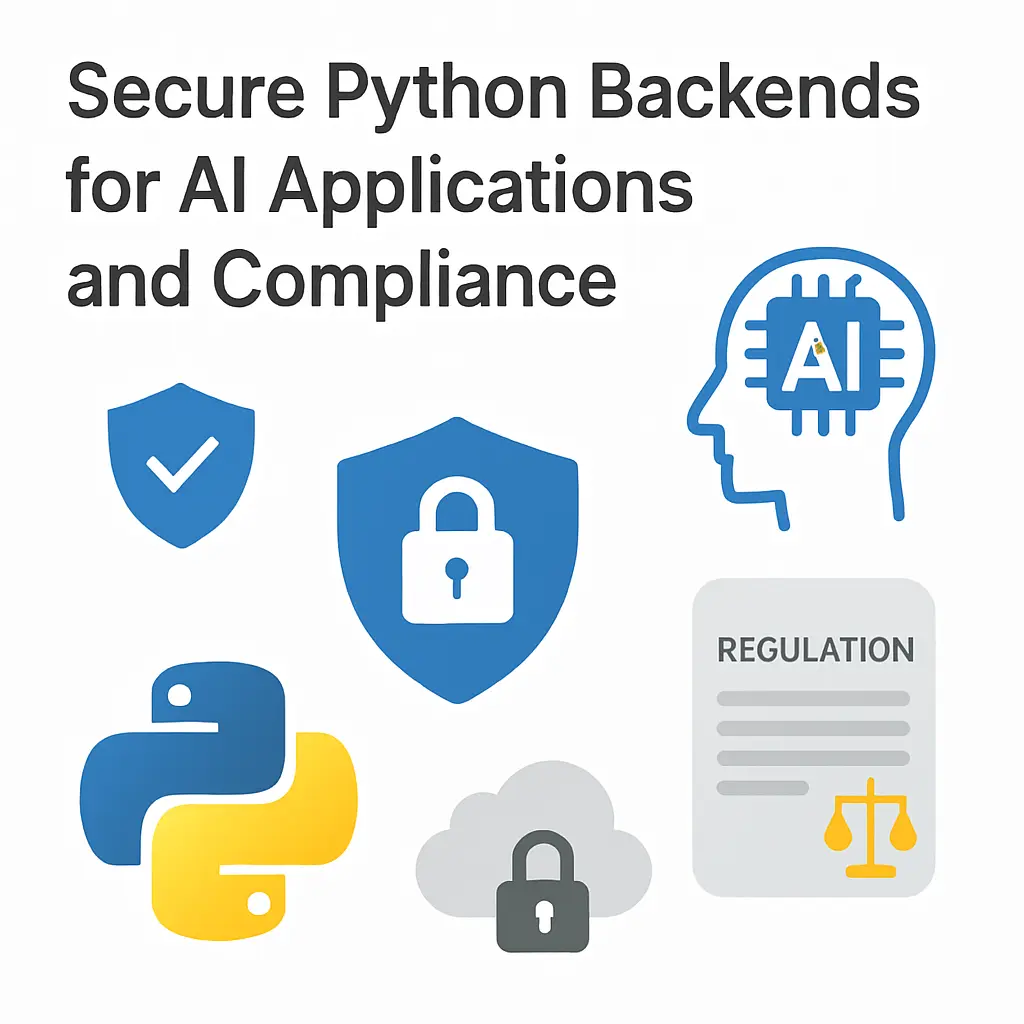
AI-driven applications are transforming how businesses operate, but building them in a secure, scalable and maintainable way is far from trivial. From choosing the right Python backend framework to enforcing rigorous security and compliance, every architectural decision affects performance, reliability and risk. This article explores how to design robust backends for AI systems, balancing experimentation speed with enterprise-grade control.
Designing the Python backend foundation for AI systems
AI applications impose different demands on backend architecture than traditional web apps. Model lifecycle management, high-throughput inference, data pipelines and observability all need to be part of the design. The choice of Python frameworks, patterns and infrastructure will strongly influence development velocity, cost and future flexibility.
Python has become the default ecosystem for machine learning and data science. That popularity brings plenty of libraries and frameworks—but also architectural temptations to throw everything into a single monolith or an overcomplicated microservice maze. A more deliberate approach asks: what qualities should an AI backend optimize for?
For most organizations, the following dimensions are crucial:
- Experimentation speed: Data scientists must quickly turn notebooks into services and iterate on models.
- Operational reliability: Once in production, models must serve traffic predictably, handle failure gracefully and degrade safely.
- Scalability and performance: Inference workloads can be resource-intensive and spiky; the backend must scale horizontally and vertically.
- Security and compliance: AI often touches sensitive data, so controls for access, auditing and governance are mandatory.
- Maintainability and team collaboration: Codebases must be understandable across data, ML and backend engineering teams.
Within this context, selecting and composing Python backend frameworks is a strategic choice. Some teams will benefit from fully featured batteries-included frameworks; others need lean, API-focused stacks tuned for microservices and inference. A good starting point is to understand the main categories of frameworks and where each shines.
Traditional full-stack frameworks like Django and Flask (the latter now more minimal than “full-stack”) are well known. Newer async-first frameworks such as FastAPI and Starlette provide better performance for IO-bound workloads and cleaner request handling for high-concurrency inference APIs. Specialized tools like BentoML, MLflow, or model server wrappers sit closer to the ML domain, helping package and deploy models with minimal boilerplate.
To make sense of this landscape in the context of real-world AI workloads, it is useful to map frameworks to use cases:
- Prototyping model-powered features quickly: Lightweight frameworks like FastAPI or Flask allow data scientists to wrap models as HTTP or gRPC endpoints with minimal ceremony.
- Enterprise AI platforms and internal tools: Django’s ORM, admin and auth system excel for building admin panels, feature stores, annotation tools and governance dashboards around your AI stack.
- High-throughput inference services: Async frameworks and model servers combined with autoscaling via Kubernetes work well for real-time use cases such as recommendations, fraud detection, or conversational interfaces.
- Batch and pipeline-oriented AI: Where offline scoring or periodic training runs dominate, frameworks integrate with workflow engines like Airflow, Prefect or Dagster rather than focusing primarily on HTTP APIs.
Properly aligning your framework choice with your ML delivery model is critical. A highly regulated bank deploying credit scoring models will pick different patterns than a startup iterating on an AI-powered SaaS tool.
Because the range of options and trade-offs is broad, many teams benefit from a deeper exploration of specific backend options. For a detailed comparison of Django, Flask, FastAPI, and more specialized stacks for serving AI workloads, it is worth reviewing Python Backend Frameworks: What to Use for AI-Driven Projects, which drills into concrete selection criteria and architecture patterns.
Beyond framework selection: structuring the service landscape
Once you pick a primary backend framework, architectural structure matters just as much as the framework itself. AI backends often fall into a few patterns:
- Monolithic application with embedded model serving: Simplest for small teams; the web app, business logic and ML inference live in a single codebase and deployment unit. This works well for low traffic or early-stage products.
- Microservice-based AI architecture: Separate services for inference, feature computation, data ingestion, and user-facing APIs. More complex but allows independent scaling and technology choices per service.
- Hybrid approach: A core monolith for user-facing logic, supplemented by separately deployed inference services or batch pipelines where scaling requirements differ.
The monolith’s advantage is reducible complexity: one deployment pipeline, one monitoring setup and limited cross-service communication. Its drawback emerges as load grows: you cannot scale inference separately from everything else, and dependencies might become tightly coupled. For many organizations, a hybrid approach is pragmatic: keep most business logic together while extracting models that need specialized scaling or GPU support into dedicated services.
Within each service, certain backend capabilities are especially important for AI:
- Request validation and schema management: Enforce typed contracts for prediction requests and responses to prevent subtle errors from malformed inputs.
- Versioning and routing: Support multiple model versions concurrently, A/B testing and canary releases at the API layer.
- Observability for AI behavior: Log not only technical metrics (latency, errors) but also model-level metrics (confidence distributions, drift indicators, feature importance summaries).
- Async processing: Offload heavy pre-processing or batch scoring to background workers via Celery, RQ, or serverless functions when appropriate.
Choosing frameworks that make these capabilities straightforward—via strong typing, dependency injection, middleware support and integrations with message queues—pays dividends later when your AI stack grows and diversifies.
Handling model lifecycle inside your backend
A robust AI backend does more than load a single trained model. It must support the full lifecycle:
- Model registration: Store metadata, signatures, performance metrics and compliance information about each model.
- Deployment orchestration: Automate packaging, containerization and rollout to various environments (staging, production, shadow deployments).
- Runtime management: Manage model loading, caching, resource allocation (CPU/GPU), and automatic failover if a model fails.
- Feedback loops: Capture production data and outcomes to retrain or fine-tune models, closing the ML feedback cycle.
General-purpose Python backends can integrate with ML platforms like MLflow, Kubeflow, or SageMaker for model registry and training pipelines, while the backend focuses on inference and business logic. The backend then acts as a governance and enforcement layer: only models satisfying certain validation checks and compliance reviews become eligible for routing traffic.
When designing such a system, it is helpful to define a clear separation of responsibilities:
- The ML platform owns experiments, training, and model evaluation.
- The backend owns request handling, application logic, access control, and routing of predictions.
- DevOps / platform engineering owns infrastructure, scaling, and runtime reliability.
This separation reduces chaos when teams grow. It also creates clear insertion points for security and compliance controls, which is where the second major theme of modern AI backends enters: how to harden them against threats and align them with regulatory and organizational requirements.
Security, compliance and risk management in AI backends
AI backends tend to process sensitive data: personal information, transaction histories, health records, internal documents, or proprietary models themselves. This intensifies the need for strong security and compliance controls at every layer of the stack—from HTTP endpoints through data storage and model execution to logging.
A secure AI backend is not just about encrypting traffic. It is about systematically identifying risks, building least-privilege architectures and embedding compliance into pipelines. The stakes are high: a model that leaks personal information, allows prompt injection to exfiltrate secrets, or enables biased decision-making without oversight can cause serious harm.
Core security principles for AI backends
At a minimum, AI API services should be engineered around familiar security guidelines, adapted to ML-specific contexts:
- Strong authentication and authorization: Protect inference and management endpoints with robust auth—OAuth2/OIDC, API keys, or mutual TLS—and fine-grained RBAC. Separate permissions for model deployment, configuration, and data access.
- Input validation and sanitization: Validate input types, ranges and formats before passing them to models to prevent injection attacks, resource exhaustion or model degradation.
- Transport and data encryption: Enforce TLS for all network traffic, encrypt sensitive data at rest, and consider field-level encryption for especially sensitive features.
- Rate limiting and abuse detection: Protect against scraping, brute force, and adversarial probing of models to infer training data or internal behavior.
- Secrets management: Store keys, credentials and tokens in secure vaults (e.g., HashiCorp Vault, AWS KMS/Secrets Manager) rather than environment variables or config files.
These principles guide middleware configuration, infrastructure-as-code templates and default policies. Python backends often provide security-related extensions or can integrate easily with existing identity providers, WAFs (Web Application Firewalls) and API gateways.
Compliance concerns specific to AI systems
Where traditional applications often focus on data protection and auditability, AI adds new compliance dimensions:
- Data lineage and consent: Be able to trace which datasets and data subjects contributed to a model, and whether consent covers the model’s use cases.
- Model explainability and accountability: Regulatory frameworks (e.g., GDPR, EU AI Act proposals, sector-specific guidelines) may require explanations of automated decisions, especially in high-risk domains like credit or healthcare.
- Bias and fairness monitoring: Track metrics over protected attributes where legally allowed, and implement alerts for drift or disparate impacts across groups.
- Retention and right-to-erasure: Ensure model training data and logs respect data retention policies, and architect mechanisms for honoring deletion requests, including their downstream effects on models.
To address these requirements, the backend must do more than serve predictions. It acts as the central gateway where constraints are enforced and evidence is collected. Key patterns include:
- Request-level metadata: Attach identifiers (e.g., customer, dataset version, consent status) to each prediction request and store them with predictions.
- Decision logging: Persist decision payloads: inputs (appropriately pseudonymized), outputs, model version, feature flags, and the triggering user or system actor.
- Policy-aware routing: Implement routing logic that selects appropriate models or feature sets depending on jurisdiction, customer segment, or product-specific policy rules.
These features turn the backend into a compliance ally rather than an obstacle. They also enable later forensic analysis in case of incidents or regulatory inquiries.
To implement these patterns effectively, software and platform teams often benefit from a structured overview of available techniques and tooling. For a broader perspective on aligning modern application architectures with such requirements, consider resources like Strengthening Security and Compliance in Modern Software Systems, which situates AI backends inside the wider ecosystem of secure and compliant software design.
Integrating security and compliance into the ML delivery workflow
AI teams frequently make the mistake of treating security and compliance as a final gate before production. That approach leads to friction and rework. Instead, build security into the same continuous delivery pipeline that handles code and model changes.
Practical strategies include:
- Secure-by-default templates: Provide boilerplate FastAPI or Django projects that already include auth, logging, input validation and rate limiting middleware.
- Automated checks in CI/CD: Run static analysis, dependency vulnerability scans, secret scanners, and infrastructure policy checks on every change to backend and ML code.
- Model approval workflows: Define promotion criteria (accuracy, fairness metrics, stability, documentation completeness) and enforce them via automated gates before deployment.
- Environment isolation: Separate dev, staging and production with distinct credentials and data access levels. Use synthetic or anonymized data where possible.
Because AI stacks change rapidly—new libraries, experimental runtimes, emerging threats—the pipeline itself must be maintainable. Favor configuration-as-code for policies and rules, so they can evolve along with frameworks and infrastructure.
Operational monitoring and incident response for AI backends
Even with strong upfront controls, operational vigilance is non-negotiable. In practice, this means:
- Unified observability: Collect logs, metrics and traces from backend services, model runtimes, databases and message queues into a single platform.
- Security-focused alerts: Monitor for anomalous traffic patterns, repeated error codes, suspicious authentication attempts and abrupt changes in input or output distributions.
- Runbooks and playbooks: Document step-by-step procedures for rolling back models, revoking credentials, rotating keys, and isolating compromised components.
- Post-incident learning: After security or reliability incidents, conduct blameless post-mortems and feed improvements back into coding standards, frameworks and pipelines.
With AI systems, incident response extends to model-specific issues: unexpected bias, harmful outputs, or prompt injection vulnerabilities in LLM-based services. Your backend should enable quick mitigation—such as toggling feature flags, switching model versions or applying additional filtering—without disruptive redeployments.
Bringing it all together: aligning architecture, frameworks and governance
Modern AI backends sit at the crossroads of data science, engineering and compliance. They must let teams iterate on models quickly while simultaneously enforcing strict controls over data, models and decisions. Achieving this balance is less about any individual framework and more about how choices fit together into a coherent architecture.
First, select Python backend frameworks that match your AI use cases and team skills: lean, async-first stacks to power inference APIs; richer frameworks to support admin, tooling and governance interfaces. Design the service landscape (monolithic, microservice or hybrid) to reflect where scaling pressure and organizational boundaries lie.
Next, weave model lifecycle support into your backend: versioning, routing, metadata tracking and feedback loops. Clearly separate platform responsibilities, so ML engineers, backend developers and DevOps teams can collaborate without stepping on each other’s domains.
Finally, embed security and compliance throughout the stack. Architect with least privilege and defense-in-depth; build automated gates into your pipelines; and keep operational vigilance through unified observability and tested incident response plans. When these pieces align, you gain an AI backend that not only performs well but also earns stakeholder trust.
By treating framework selection, architecture patterns and governance mechanisms as parts of the same design problem, organizations can unlock the full potential of AI without sacrificing safety or compliance. This integrated approach positions your AI systems to grow responsibly—from early experiments to mission-critical, regulated production workloads.